

A test without context is just a number. An app without data is just education. The reason Insara built both a metabolic testing kit and a dedicated app is that neither one tells the full story on its own.
This guide walks through exactly how the Insara Metabolic Kit and the Insara App connect, what each product does individually, and what becomes possible when you use them together.
The Problem They Both Solve
Most women with PCOS/PMOS share two connected frustrations.
The first is that they cannot get fasting insulin tested. Standard blood panels do not include it. Some providers order it when asked. Many do not. Even women who know their insulin matters often cannot access the test.
The second is that when they do get results, the numbers arrive without context. A fasting insulin of 18 mIU/mL comes back labelled “normal” by the lab because the reference range goes up to 25. Nobody explains that research supports a threshold of below 8. Nobody connects the result to the acne, the irregular cycles, or the stubborn weight.
The Insara Metabolic Kit solves the access problem. The Insara App solves the context problem. Together, they close the loop.
What the Insara Metabolic Kit Does
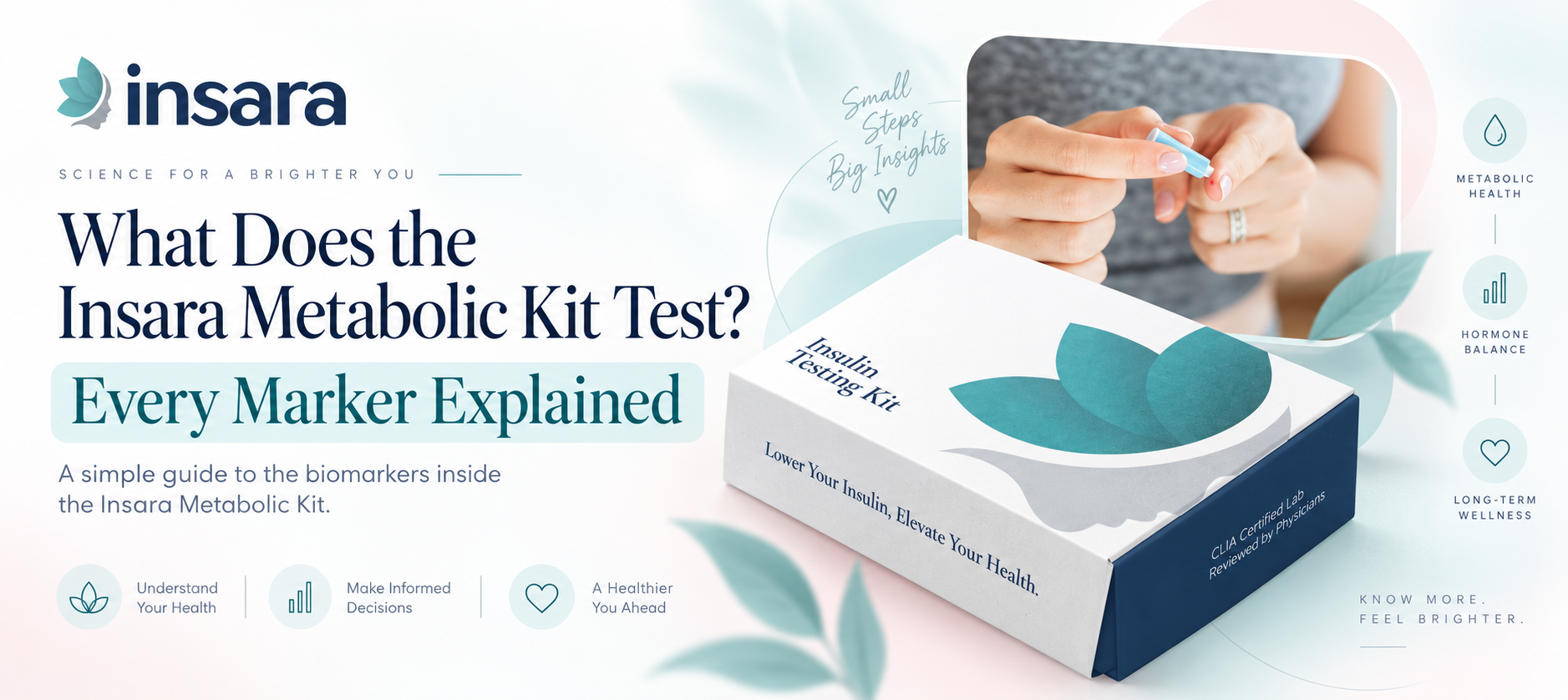
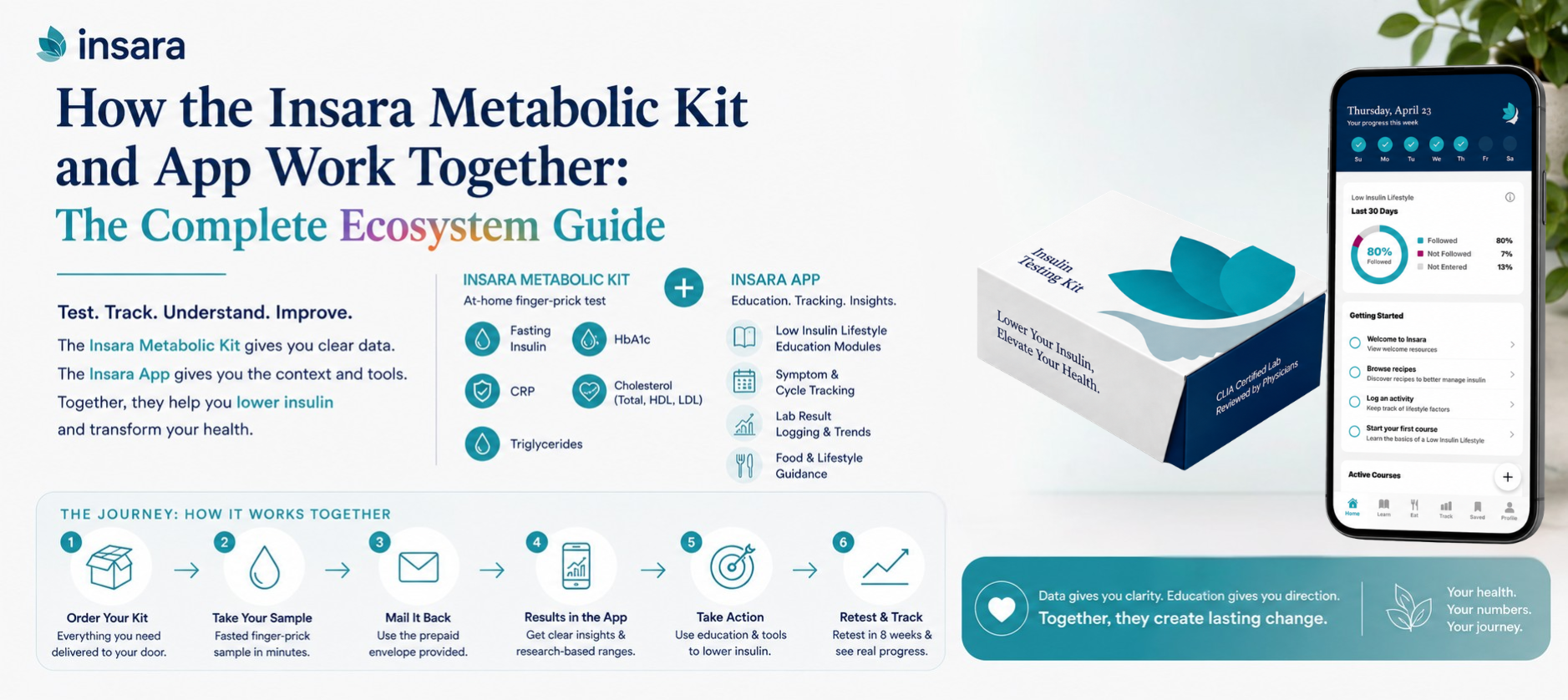
The Insara Metabolic Kit is an at-home finger-prick blood test. It measures five markers:
| Marker | Why It Matters for PCOS/PMOS |
|---|---|
| Fasting Insulin | The most direct measurement of insulin resistance. Elevated in up to 95% of women with PCOS. |
| HbA1c | Average blood glucose over ~3 months. Reflects longer-term glucose patterns. |
| High-Sensitivity CRP | A marker of systemic inflammation, closely linked to insulin resistance. |
| Cholesterol (total, HDL, LDL) | Cardiovascular risk markers, often affected by insulin dysregulation. |
| Triglycerides | Frequently elevated with high insulin. A key indicator of metabolic health. |
The test is CLIA-certified and CAP-accredited, which means it meets the same laboratory standards used in clinical facilities. You collect the sample at home, mail it with the prepaid packaging, and the results arrive in your Insara App within 3 to 7 days.
What the Kit Does Not Do
The kit does not diagnose any condition. It does not provide medical advice. It does not replace the clinical interpretation of a qualified healthcare provider. What it does is give you your actual numbers, in your hands, without a provider referral. You can then bring those results into a provider conversation with something concrete to discuss.
What the Insara App Does
The Insara App is free to download and includes several interconnected features:
Low Insulin Lifestyle Education Modules Based on 15 years of research and three published clinical studies, the app walks you through the science of insulin resistance and how diet, movement, sleep, and stress affect your insulin levels. The modules explain why specific foods spike insulin more than others, how to build meals that keep insulin lower throughout the day, and what to expect as your body responds to lifestyle change.
Symptom and Cycle Tracking Log your menstrual cycle, energy levels, mood, skin changes, hair, cravings, and other symptoms associated with PCOS/PMOS. Over time, the app builds a picture of how your symptom patterns relate to your tracked habits and lab results.
Lab Result Logging Whether your results come from the Insara Metabolic Kit or from a provider’s blood panel, you can log and track them in the app. Fasting insulin, HbA1c, CRP, cholesterol, triglycerides, and hormonal markers can all be recorded over time so you can see your trends.
Food and Lifestyle Guidance The app includes practical meal ideas, grocery guidance, and swap suggestions based on the insulin response of foods rather than calorie content. This is the core distinction of the Low Insulin Lifestyle: the question is not how many calories a food contains, but how much insulin it triggers.
How the Kit and App Work Together: The Full Journey
Here is the complete user journey from kit to app and beyond:
Step 1: Order the Insara Metabolic Kit
The kit arrives at your home with everything you need: a lancet, sample collection card, prepaid return envelope, and clear instructions.
Step 2: Take Your Sample (Fasted)
Fast overnight. The next morning, use the lancet to collect a small finger-prick blood sample onto the collection card. The whole process takes about five minutes.
Step 3: Mail the Sample
Seal the sample card in the prepaid envelope and mail it to the CLIA-certified laboratory. No postage needed.
Step 4: Results Arrive in the App
Within 3 to 7 business days, your results appear in the Insara App. Each marker includes:
- Your actual result
- What the result means in plain English
- Where it sits relative to the research-based optimal ranges
- What you can discuss with a healthcare provider
Step 5: Start or Refine Your Low Insulin Lifestyle
With your baseline established, you begin or continue working through the Low Insulin Lifestyle modules in the app. You now know which specific markers need the most attention and can track how your habits are affecting them.
Step 6: Retest at 8 Weeks
The clinical research behind Insara showed meaningful changes in fasting insulin, free testosterone, and other metabolic markers within 8 weeks. Retesting at this point gives you data on whether your approach is working. Many women find this the most motivating part of the process: seeing their numbers actually change.
Why “Together” Is More Powerful Than Either Alone
| Using Only the Kit | Using Only the App | Using Both |
|---|---|---|
| You have numbers but no context | You have education but no data | You have numbers AND the framework to understand and act on them |
| Hard to know what to prioritise | Hard to know if your changes are working | You can track cause and effect directly |
| Results may feel abstract | Progress can feel intangible | Progress becomes measurable |
| One data point | Ongoing tracking without baseline | Trend data showing real change over time |
The kit makes your insulin visible. The app makes it actionable. That combination is what Insara was built to provide.
Who This System Is Designed For
Women with PCOS/PMOS who have never had fasting insulin tested, or whose providers have not ordered it, or who want to track their progress over time as they follow the Low Insulin Lifestyle.
Women with suspected insulin resistance who have symptoms (fatigue, cravings, weight around the midsection, irregular cycles, skin changes) but whose standard labs have come back normal.
Women who have had a fasting insulin test through a provider but want an easier way to retest regularly and track their numbers in one place.
Women who are pregnant or postpartum and want to monitor their metabolic markers during a time when insulin resistance often shifts significantly.
Frequently Asked Questions
You can use the Insara App on its own for education and symptom tracking. You can also use the kit results in the app even if you tested through a provider rather than purchasing the kit. But the two are designed to work together, and the most complete picture comes from using both.
Once your sample is processed, results are automatically delivered to your Insara App account. You will receive a notification when they are ready.
The Insara Metabolic Kit uses CLIA-certified and CAP-accredited laboratory processing, which meets the same quality and accuracy standards as clinical laboratory facilities. The finger-prick collection method is standard for at-home testing and has been validated for the markers the kit measures.
Yes. You can view, save, and share your results directly from the app. Bringing your results to a provider conversation is one of the primary use cases for the kit.
The clinical research behind Insara showed meaningful changes in 8 weeks. For most women actively following the Low Insulin Lifestyle, retesting at 8 to 12 weeks gives useful feedback. After that, twice-yearly monitoring is reasonable for ongoing tracking.
If any of your results fall significantly outside the optimal ranges, the app will explain what that means and what to discuss with a healthcare provider. The kit results do not constitute a diagnosis, and any result that concerns you should be reviewed by a qualified clinician.
Yes. Fasting insulin, HbA1c, CRP, cholesterol, and triglycerides are relevant metabolic markers for all adults. While the Insara App’s education is focused on women with PCOS/PMOS, the kit itself measures markers that are universally relevant.
References:
- Nilsson M, Stenberg M, Frid A. Glycemia and insulinemia in healthy subjects after lactose-equivalent meals of milk and other food proteins: the role of plasma amino acids and incretins. The American Journal of Clinical Nutrition, 80, 1246-1253 https://ajcn.nutrition.org/article/S0002-9165(22)03683-8/fulltext
- Salehi A, Gunnerud U, Muhammed SJ, Ostman E, Holst JJ, Björck I, Rorsman P. The insulinogenic effect of whey protein is partially mediated by a direct effect of amino acids and GIP on β-cells. Nutr Metab (Lond). 2012 May 30;9(1):48. https://pmc.ncbi.nlm.nih.gov/articles/PMC3471010/
- Kolic, J., Assaf, N. & Johnson, J.D. Nutrient and non-nutrient regulators of insulin secretion. Nat Rev Endocrinol (2026). https://doi.org/10.1038/s41574-026-01281-6. https://www.nature.com/articles/s41574-026-01281-6