

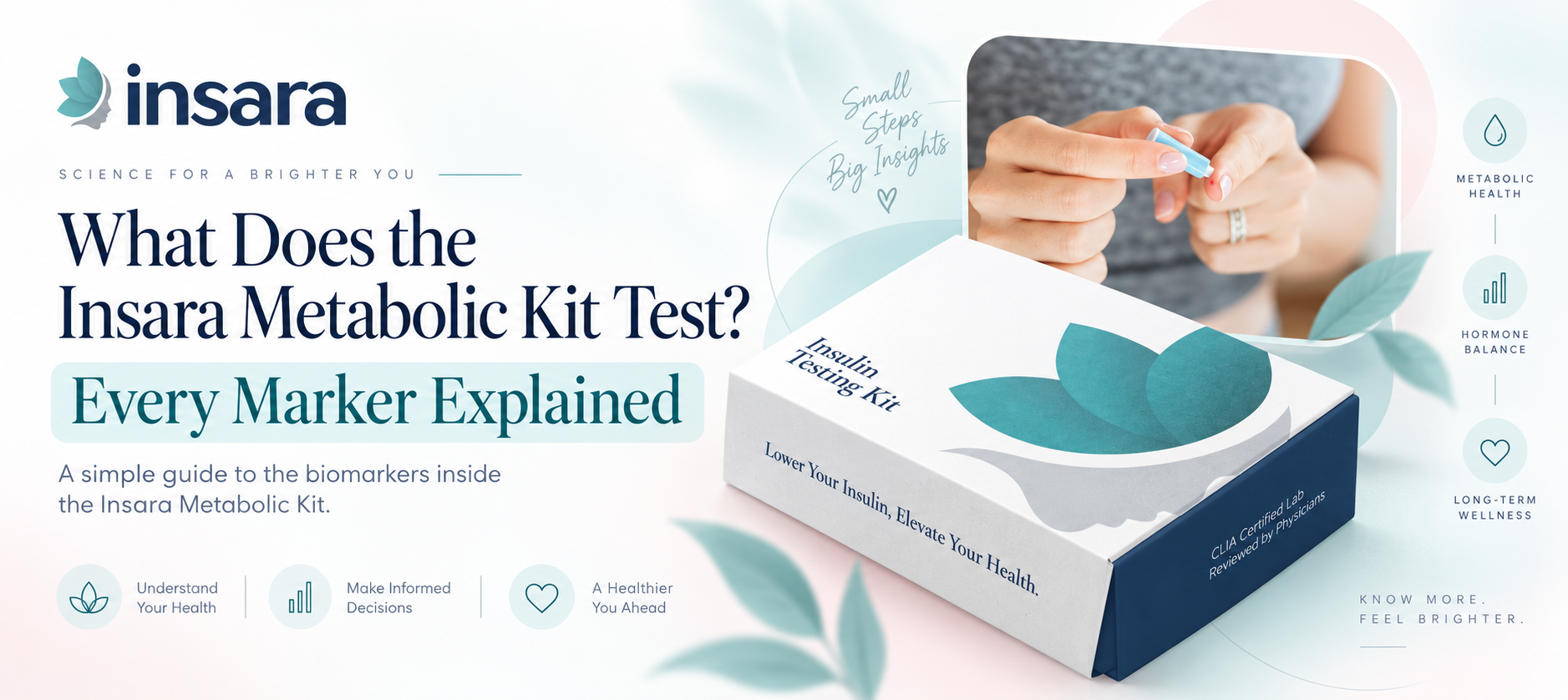
Before you buy any health test, you should know exactly what it measures and why. The Insara Metabolic Kit tests five specific markers. Every one was chosen deliberately — not to give you a broad snapshot of general health, but to answer the specific question that matters most for PCOS/PMOS: what is your insulin doing, and what has it done to the rest of your metabolic picture?
Here is a complete explanation of every marker, why it is included, and what it tells you.
How the Insara Metabolic Kit Works
Before getting into the markers themselves: the kit uses a single at-home finger-prick blood sample, collected after an overnight fast. The sample is mailed to a CLIA-certified and CAP-accredited laboratory — the same quality standard as a clinical lab — and results appear in the Insara App within 3 to 7 business days.
The collection takes approximately five minutes. You receive results with plain-English explanations, educational context, and guidance on what to discuss with a healthcare provider.
The Five Markers
Marker 1: Fasting Insulin
Why this marker is included: Fasting insulin is the most direct measurement available for insulin resistance — the metabolic root cause of up to 95% of PCOS cases. It is not included on a standard blood panel, which means most women with PCOS have never had it tested.
Elevated insulin drives androgen overproduction in the ovaries, disrupts the LH/FSH signaling that governs ovulation, promotes visceral fat storage, and contributes to every major symptom of PCOS. Fasting insulin rises before blood sugar changes, before HbA1c shifts, and often years before standard tests would flag anything.
What it measures: How much insulin your pancreas is releasing in the rested, fasted state. The lower the result, the more efficiently your cells are responding to insulin and the less your pancreas has to compensate.
Research-supported optimal range: 3.0 to 8.0 mIU/mL
Why Insara chose it: It is the most actionable measurement available for PCOS management. Everything else in the kit provides context around it.
Marker 2: HbA1c (Hemoglobin A1c)
Why this marker is included: HbA1c provides the three-month blood glucose picture. Fasting insulin shows what your pancreas is doing to keep glucose normal, and HbA1c shows whether it is succeeding over time.
In PCOS, HbA1c often remains completely normal while fasting insulin is already elevated. This is one of the most important things to understand about early insulin resistance: glucose and A1c can look fine for years while insulin has been climbing. Including both measurements in the kit allows you to see where you are in that progression.
What it measures: Average blood glucose over approximately the past three months, expressed as a percentage.
Research-supported optimal range: Below 5.7%
Why Insara chose it: It contextualizes the fasting insulin result and gives you the glucose picture that insulin alone cannot provide.
Marker 3: High-Sensitivity CRP (hsCRP)
Why this marker is included: Chronic low-grade inflammation is both a driver and a consequence of insulin resistance. The two conditions reinforce each other in a self-perpetuating cycle that is characteristic of PCOS. High-sensitivity CRP is the most accessible and reliable marker of this background inflammation.
Standard CRP tests detect acute inflammation from infection or injury. High-sensitivity CRP detects the lower-grade, chronic inflammation that is the metabolically relevant kind for PCOS and insulin resistance.
What it measures: The level of C-reactive protein in the blood in the fasted state, reflecting the body’s current state of chronic systemic inflammation.
Research-supported optimal range: Below 1.0 mg/dL
Why Insara chose it: Inflammation is an underappreciated driver of PCOS severity, and it responds to the same dietary and lifestyle changes that lower insulin. Tracking it alongside insulin shows you the full metabolic picture.
Marker 4: Cholesterol Panel (Total Cholesterol, HDL, LDL)
Why this marker is included: Chronically elevated insulin has specific and measurable effects on cholesterol patterns. It suppresses HDL (the so-called “good” cholesterol) and contributes to an unfavourable LDL particle profile. In PCOS, the cardiovascular risk is real and significantly higher than in the general female population — women with PCOS have a meaningfully elevated lifetime risk of cardiovascular disease.
Including a cholesterol panel gives you the cardiovascular risk context alongside the metabolic one. The combination of low HDL and elevated triglycerides, both driven by elevated insulin, is one of the most specific lipid patterns of insulin resistance.
What it measures:
- Total cholesterol: the overall level of cholesterol in the blood
- HDL (high-density lipoprotein): the cholesterol carrier that removes cholesterol from arteries — higher is better
- LDL (low-density lipoprotein): the carrier associated with cardiovascular risk — lower is generally better
Research-supported ranges:
- Total cholesterol: optimal below 200 mg/dL
- HDL: optimal above 60 mg/dL (higher is better)
- LDL: optimal below 130 mg/dL
Why Insara chose it: It completes the metabolic risk picture and gives you and your provider something concrete for cardiovascular risk assessment, which is particularly important for PCOS.
Marker 5: Triglycerides
Why this marker is included: Fasting triglycerides are one of the earliest and most sensitive metabolic signs of elevated insulin. When insulin is chronically high, it signals the liver to convert excess carbohydrates into triglycerides and release them into the bloodstream. Elevated triglycerides often appear before other metabolic markers shift, making them an important early signal.
The triglyceride-to-HDL ratio — calculated by dividing triglycerides by HDL — correlates closely with insulin resistance in research and is sometimes used as a proxy marker when fasting insulin is not available. Low HDL alongside elevated triglycerides is one of the most consistent lipid patterns in PCOS.
What it measures: The level of fat circulating in the blood in the fasted state.
Research-supported optimal range: Below 150 mg/dL
Why Insara chose it: It is one of the first metabolic markers to respond to the Low Insulin Lifestyle. In the Insara clinical research, participants saw triglycerides fall by 35% in eight weeks. It is also a strong early marker of metabolic risk when fasting insulin is not available.
Why These Five Markers Together
Each marker tells you something different. Together they give you a full metabolic picture.
| What You Want to Know | Marker That Answers It |
|---|---|
| Is my insulin elevated? | Fasting insulin |
| Has elevated insulin affected my blood sugar over time? | HbA1c |
| Is there chronic inflammation alongside the insulin resistance? | High-sensitivity CRP |
| Has elevated insulin affected my cardiovascular lipids? | Cholesterol panel |
| How early is the metabolic disruption? | Triglycerides |
The combination was chosen to give you the upstream picture (fasting insulin, the root driver), the downstream picture (HbA1c, CRP, cholesterol), and the early-warning signal (triglycerides) — all from a single sample.
What the Kit Does Not Test
The Insara Metabolic Kit is specifically designed around metabolic and insulin-related markers. It does not test:
- Reproductive hormones (LH, FSH, oestradiol, testosterone, AMH)
- Thyroid function (TSH, free T3, free T4)
- Vitamins and nutrients (vitamin D, B12, iron)
- Raw fasting glucose (though HbA1c reflects your glucose average)
If you want hormonal markers or thyroid function alongside your metabolic results, complementary testing through your provider or through a service like Labcorp OnDemand or Ulta Lab Tests can fill those gaps.
Frequently Asked Questions
Yes. The kit uses CLIA-certified and CAP-accredited laboratory processing, which meets the same accuracy and quality standards as clinical laboratory facilities. Finger-prick sample collection is a validated method for the markers the kit measures.
Most standard blood panels focus on glucose-based markers (fasting glucose, HbA1c) for metabolic screening. Fasting insulin is not part of standard clinical screening guidelines, which is why it is so commonly missed. It needs to be specifically requested — or tested at home with the Insara Metabolic Kit.
Yes. The kit requires a minimum of eight hours of fasting, ideally overnight, before you collect your sample. Water is fine. Coffee, food, and supplements should be avoided during the fast.
The Insara Metabolic Kit covers metabolic markers specifically. For reproductive hormone testing (testosterone, LH, FSH, oestradiol), Labcorp OnDemand or Ulta Lab Tests offer direct-to-consumer hormonal panels you can order separately.
Yes. Your results are CLIA-certified laboratory data that your provider can interpret exactly as they would results from a clinical lab. You can view, save, and share results directly from the Insara App.
For women actively following the Low Insulin Lifestyle, retesting at eight to twelve weeks provides meaningful feedback on whether lifestyle changes are producing results. After stabilizing, twice-yearly testing is reasonable for ongoing monitoring.