

If you have PCOS/PMOS and you have ever had a routine blood panel come back with results in the normal range, while still feeling like something is clearly off with your body, this distinction is for you.
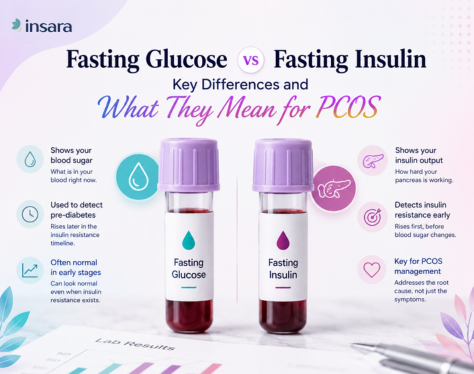
Fasting glucose and fasting insulin are both blood tests. Both require an overnight fast. Both are measured in a similar way. But they measure entirely different things — and for women with PCOS, one of them tells you significantly more than the other.
Understanding what each test actually captures, and what it misses, is one of the most practically useful things you can know about managing your metabolic health.
The Short Version
Fasting glucose measures the level of sugar in your blood after an overnight fast. It tells you what blood sugar is doing right now.
Fasting insulin measures the level of insulin your pancreas is producing in the fasted state. It tells you how hard your pancreas is working to keep blood sugar in its normal range.
These sound similar. They are not. And for insulin resistance, the metabolic driver behind up to 95% of PCOS cases, fasting insulin is the test that catches the problem early. Fasting glucose often misses it entirely for years or decades.
What Fasting Glucose Measures
Fasting glucose measures how much sugar is circulating in your bloodstream after you have not eaten for at least eight hours. It reflects the balance between how much glucose your liver is releasing into circulation and how effectively your cells are absorbing it.
This test is included on almost every standard blood panel. It has been the primary screening tool for diabetes and prediabetes for decades.
Standard fasting glucose reference ranges:
| Result | Fasting Glucose | What It Indicates |
|---|---|---|
| Normal | Below 100 mg/dL | Blood sugar well-regulated in fasted state |
| Prediabetes range | 100 to 125 mg/dL | Elevated — lifestyle intervention most effective here |
| Diabetes threshold | 126 mg/dL and above | Meets diagnostic criteria — provider review needed |
Fasting glucose is a legitimate and important test. It becomes the primary guide for managing diabetes once blood sugar has already risen. The limitation for PCOS management is where it fits in the sequence of metabolic dysfunction.
What Fasting Glucose Misses
In the early stages of insulin resistance, blood glucose stays normal. This is because the pancreas compensates by producing more insulin to keep blood sugar in range. As long as the pancreas can keep up, glucose looks fine on a test.
This compensatory phase, completely normal glucose maintained by chronically elevated insulin, can last for a decade or longer. During this entire window, a fasting glucose test would return a normal result. For someone with PCOS, all the symptoms driven by that elevated insulin (irregular cycles, androgen-driven acne, fatigue, weight changes, carbohydrate cravings) are already present and progressing. But the glucose test would not reflect any of that.
What Fasting Insulin Measures
Fasting insulin measures how much insulin your pancreas is releasing into the bloodstream after an overnight fast. It reflects the output required to maintain normal blood sugar in the absence of food.
When cells respond efficiently to insulin, the pancreas produces a relatively small amount to achieve the desired effect. When cells are insulin resistant, meaning they respond less readily to insulin’s signal, the pancreas has to produce more to achieve the same result. Fasting insulin captures this extra output directly.
This makes fasting insulin the more sensitive early marker for insulin resistance. It rises before blood sugar shifts. It rises before HbA1c shifts. For many women, fasting insulin has been elevated for years before any other standard lab marker moves.
The Optimal Threshold That Standard Labs Do Not Use
This is where the clinical picture gets particularly important for PCOS. Standard laboratory reference ranges for fasting insulin are typically set at population-average levels, often flagging concerns only above 20 or 25 mIU/mL.
Research literature supports a meaningfully different threshold. Studies examining metabolic outcomes in PCOS and insulin resistance populations point to a fasting insulin below 8 mIU/mL as the evidence-based optimal range. A result of 15 or 18 mIU/mL — which a standard lab would return as normal — is well above this threshold.
Research-supported fasting insulin ranges:
| Category | Fasting Insulin | What It Reflects |
|---|---|---|
| Optimal | 3.0 to 8.0 mIU/mL | Option insulin sensitivity |
| Moderately elevated | 8.0 to 12.0 mIU/mL | Early insulin resistance signal |
| Moderate to high | 12.0 to 20.0 mIU/mL | Significant insulin resistance |
| Very high | Above 20.0 mIU/mL | Marked hyperinsulinemia — provider conversation warranted |
These ranges are for educational reference based on research literature. All results should be interpreted by a qualified healthcare provider in the context of your full clinical picture.
Why Fasting Insulin Is Not on a Standard Blood Panel
Fasting insulin is not included in routine blood panels because standard clinical guidelines have historically centred glucose-based markers (fasting glucose, HbA1c) as the primary tools for metabolic screening. These were largely built around diagnosing type 2 diabetes, which is a later-stage condition.
Fasting insulin is an earlier signal that was not incorporated into standard screening protocols at the same scale. That is slowly changing as the clinical relevance of early insulin resistance, particularly in PCOS, becomes more widely recognized. For now, fasting insulin almost always requires a specific request.
HbA1c: The Third Marker Worth Understanding
Both fasting glucose and fasting insulin are single-point snapshots. HbA1c (hemoglobin A1c) offers a different perspective—it reflects average blood glucose over approximately the past three months by measuring how much glucose has attached to hemoglobin in red blood cells.
HbA1c is genuinely useful for tracking longer-term glucose patterns. But it shares the same fundamental limitation as fasting glucose for PCOS: it measures blood sugar, not insulin. HbA1c can remain well within the normal range (typically below 5.7%) while fasting insulin has been significantly elevated for years.
For women with PCOS, the most complete metabolic picture comes from looking at all three: fasting glucose, HbA1c, and fasting insulin together. The first two tell you what blood sugar is doing. The third tells you what it is costing your pancreas to keep it there.
The Four Metabolic Scenarios
Understanding how fasting glucose and fasting insulin interact with each other helps you interpret your own results more clearly.
| Fasting Glucose | Fasting Insulin | What It Suggests | What to Do |
|---|---|---|---|
| Normal | Optimal (below 8) | Healthy metabolic function | Maintain current lifestyle |
| Normal | Elevated (above 8) | Early insulin resistance — pancreas compensating | Lifestyle intervention is most effective right now |
| Elevated | Elevated | More advanced insulin resistance | Provider review alongside lifestyle change |
| Elevated | Normal or low | Possible pancreatic exhaustion — later stage | Medical management likely needed |
The second scenario, normal glucose with elevated insulin, is the most important and the most commonly missed. This is exactly where the PCOS audience often sits. Standard panels clear them on glucose. The fasting insulin tells the real story.
The Third Test: Post-Meal Insulin (Oral Glucose Tolerance Test with Insulin)
There is an important third option that neither a basic fasting glucose test nor a fasting insulin test alone captures: the insulin response to a glucose challenge.
The oral glucose tolerance test (OGTT) with insulin measured at one and two hours shows not just your fasting levels but how dramatically your insulin spikes in response to glucose — and how long it stays elevated. For some women, particularly those with lean PCOS, fasting insulin can appear within the normal range while post-meal insulin reaches extreme levels.
In my own clinical research, I have documented women whose post-meal insulin reached over 300 mIU/mL during a glucose challeng, levels that would never be visible in a fasting-only test.
If you have a normal or near-normal fasting insulin but still have significant PCOS symptoms, asking your provider about a one-hour or two-hour OGTT with insulin measured alongside glucose at each time point gives you the most complete picture available.
You can also order this test directly through our partner Ulta Lab Tests without a provider referral:
Order the Insulin Response to Glucose Test via Ulta Lab Tests
A Head-to-Head Comparison
| Fasting Glucose | Fasting Insulin | OGTT with Insulin | |
|---|---|---|---|
| What it measures | Blood sugar levels after an overnight fast | Insulin levels after an overnight fast | Both glucose and insulin after an overnight fast and across the post-meal window |
| Detects early insulin resistance | Usually no | Yes | Yes — most sensitively |
| Included on standard panels | Usually yes | Usually no | Requires specific request |
| Rises before the other | No — rises later | Yes — rises first | Shows post-meal patterns neither fasting test captures |
| Most relevant for PCOS | Partial context | Yes — primary marker | Yes — especially for lean PCOS |
| What it misses | Early IR; compensatory hyperinsulinemia | Post-meal insulin spikes in lean PCOS | Not needed if both fasting markers are clearly elevated |
What the Clinical Research Shows
The three published clinical studies behind the Insara platform demonstrate what happens when fasting insulin is prioritized as the primary outcome measure rather than blood glucose:
- Pilot study: Fasting insulin dropped by 52% in eight weeks through the Low Insulin Lifestyle alone — without calorie restriction, without medication, without required exercise
- Metabolic study: Improved fat-burning capacity alongside measurably reduced insulin
- Randomized controlled trial: 35% drop in fasting insulin in eight weeks — during COVID conditions — alongside 17 lbs of average weight loss
These results were only possible to measure and demonstrate because fasting insulin was tested directly. If only fasting glucose had been measured, many of these improvements would have been invisible — glucose and A1c were normal for all participants at the start.
You can read more about the research here:
How to Get Tested: Three Options
Option 1: Request Fasting Insulin from Your Healthcare Provider
Ask your provider to add fasting insulin to your next blood panel. A straightforward way to frame this: “I would like to include fasting insulin alongside my fasting glucose and HbA1c — I have read that it provides an earlier picture of insulin resistance.”
Most providers are happy to add it. It is a simple, inexpensive blood draw processed by any standard clinical laboratory.
Option 2: Test at Home with the Insara Metabolic Kit
The Insara Metabolic Kit measures fasting insulin alongside HbA1c, high-sensitivity CRP, cholesterol, and triglycerides from a single at-home finger-prick blood sample. Results arrive in the Insara App within 3 to 7 business days, processed by a CLIA-certified and CAP-accredited laboratory. Each result comes with a plain-English explanation and educational context from the research behind the Low Insulin Lifestyle.
Option 3: Order the Insulin Response to Glucose Test via Ulta Lab Tests
For the most complete picture, especially for women who suspect lean PCOS or who have a normal fasting insulin but persistent symptoms, the insulin response to glucose test measures both glucose and insulin at one and two hours after a glucose challenge. This is available to order directly without a provider referral through our partner Ulta Lab Tests.
Order the Insulin Response to Glucose Test
What to Do Once You Have Your Results
If your fasting glucose is normal and your fasting insulin is also below 8 mIU/mL: Your metabolic function is in a healthy range. Retest in six to twelve months to monitor the trend, particularly as you age or if symptoms change.
If your fasting glucose is normal but fasting insulin is above 8 mIU/mL: This is the most common and most actionable pattern in PCOS. Your blood sugar is being maintained, but insulin is elevated to achieve it. The Low Insulin Lifestyle is your most directly relevant tool here — and the window where lifestyle intervention is most effective. Start the Insara App education modules and consider retesting at eight weeks.
If both fasting glucose and fasting insulin are elevated: Bring both results to a healthcare provider. This picture warrants clinical assessment alongside lifestyle change.
If your fasting insulin is normal but you still have symptoms: Consider the OGTT with insulin to assess your post-meal response. Lean PCOS in particular can present with a normal fasting insulin while having a dramatically elevated post-meal insulin pattern.
The Insara App lets you log and track your fasting insulin, HbA1c, and all other metabolic markers over time so you can see your trend across multiple tests.
HOMA-IR: Combining Both Markers
If you have both a fasting insulin and a fasting glucose result, you can calculate your HOMA-IR (Homeostatic Model Assessment of Insulin Resistance) — a calculation that uses both values together to give a more refined picture of insulin resistance than either marker alone.
The formula: (Fasting Insulin in mIU/mL × Fasting Glucose in mg/dL) ÷ 405
A HOMA-IR score above 2.0 to 2.5 is generally considered to indicate insulin resistance in research literature. The score is particularly useful for tracking improvement over time — if both fasting insulin and fasting glucose improve, HOMA-IR reflects that proportionally.
You can read a detailed explanation of HOMA-IR here.
Frequently Asked Questions
Fasting glucose measures how much sugar is in your blood after an overnight fast. Fasting insulin measures how much insulin your pancreas is producing in that same fasted state. They are related but measure different things — and in the early stages of insulin resistance, glucose stays normal while insulin is already elevated.
Fasting insulin is the more directly relevant test for PCOS management. Elevated insulin is the upstream driver of most PCOS symptoms including androgen excess, irregular cycles, and difficulty with weight. Fasting glucose tells you what blood sugar is doing; fasting insulin tells you what is driving it. Both together give the most complete picture.
Standard clinical panels were built primarily around glucose-based markers for metabolic and diabetes screening. Fasting insulin is available and can be ordered, but it requires a specific request in most clinical settings. It is not automatically included the way fasting glucose is.
Yes — and this is extremely common in PCOS. In early insulin resistance, the pancreas compensates by producing more insulin to keep blood sugar in the normal range. Glucose looks fine on a test. Fasting insulin, if measured, would show the elevated output the pancreas is producing to achieve that normal glucose result.
Research literature supports a fasting insulin below 8 mIU/mL as the evidence-based optimal threshold. Standard laboratory reference ranges are typically set much higher, so a result can be reported as normal while still being above the research-supported optimal level.
The OGTT with insulin measures both blood glucose and insulin levels at set intervals — typically one and two hours — after drinking a glucose solution. This test captures the post-meal insulin response, which can be dramatically elevated even when fasting insulin appears normal. This pattern is particularly relevant for lean PCOS. The test is available to order directly through our Ulta Lab Tests partner.
The Insara Metabolic Kit is a CLIA-certified and CAP-accredited at-home finger-prick test that measures fasting insulin alongside HbA1c, high-sensitivity CRP, cholesterol, and triglycerides. You collect the sample at home after an overnight fast, mail it with the prepaid packaging, and results appear in the Insara App within 3 to 7 business days.
No. HbA1c reflects average blood glucose over approximately three months. Like fasting glucose, it measures blood sugar not insulin output. HbA1c can remain entirely normal while fasting insulin is significantly elevated. The two tests measure different things and together with fasting insulin give the most complete metabolic picture.
For women with PCOS actively following the Low Insulin Lifestyle, retesting at eight to twelve weeks gives meaningful feedback on whether lifestyle changes are producing results. After results stabilize, twice-yearly monitoring is a reasonable approach for ongoing tracking.
Yes, if you have both fasting insulin and fasting glucose. The Insara Metabolic Kit provides fasting insulin. If you have a recent fasting glucose from a provider’s panel, the calculation is: (fasting insulin × fasting glucose) ÷ 405. A score above 2.0 to 2.5 is generally used to indicate insulin resistance.