

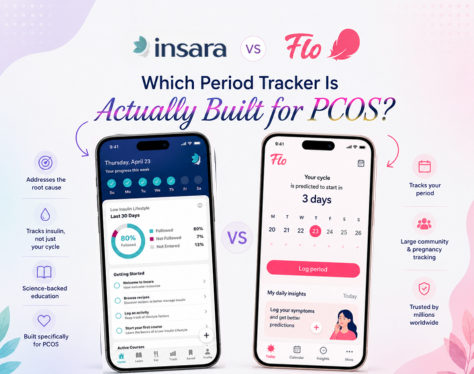
Flo is the most downloaded period tracking app in the world. With more than 440 million downloads and over 70 million monthly active users, it is the default choice for women who want to track their cycle.
For women with PCOS/PMOS, it is also the most commonly used app, and often the most frustrating one.
Not because Flo is a bad app. It is genuinely good at what it does. The frustration comes from what it does not do: address insulin resistance, the underlying metabolic mechanism that drives most PCOS symptoms.
This comparison looks at both apps honestly, feature by feature, and explains the difference that actually matters for women managing this condition.
The Core Difference in One Sentence
Flo tracks your cycle. Insara addresses what is disrupting it.
That is the fundamental distinction. Flo’s job is to predict when your next period will arrive and log the symptoms that appear in the meantime. Insara’s job is to help you understand why those symptoms are happening and give you the tools to change them.
For a woman without PCOS, Flo might be exactly what she needs. For a woman with PCOS, whose irregular cycles, acne, fatigue, and weight struggles all trace back to elevated insulin, the gap between “track the symptom” and “understand the cause” is where health management either succeeds or stalls.
Feature-by-Feature Comparison
| Feature | Insara | Flo |
|---|---|---|
| Core focus | Insulin resistance and metabolic health | Period and cycle tracking |
| PCOS-specific mode | Built entirely around PCOS/PMOS | PCOS mode available (adjusts cycle algorithm) |
| Insulin education | Yes — full Low Insulin Lifestyle program | No |
| Fasting insulin tracking | Yes — logs and tracks over time | No |
| At-home lab test integration | Yes — Insara Metabolic Kit | No |
| Cycle tracking | Yes | Yes — industry-leading prediction |
| Symptom logging | Yes — PCOS-specific symptoms | Yes — 70+ symptoms |
| Food/nutrition guidance | Yes — insulin-response focused | General only (Premium) |
| Metabolic health content | Yes — research-based | No |
| Expert team | PhD, RD, PCOS researcher | 120+ doctors and health experts |
| Community features | No | Yes — large community |
| Pregnancy mode | No | Yes — full pregnancy tracker |
| Perimenopause tracking | Partial | Yes — dedicated mode |
| Data privacy | Standard | ISO 27001 certified (2025) |
| Free tier | Yes — full education access | Yes — basic cycle tracking |
| Platforms | iOS and Android | iOS and Android |
Where Flo Excels
Flo’s period prediction algorithm is genuinely good. For women with PCOS who have irregular cycles, Flo’s PCOS mode widens the predicted fertile window and stops penalising users for being “late.” The app handles anovulatory cycles better than most general period trackers.
The symptom logging is comprehensive. You can track more than 70 symptoms, including PCOS-specific ones like hirsutism, acne severity, and bloating. The correlation feature in Premium shows you how symptoms relate to your cycle phase over time, which can be useful for identifying patterns.
Flo’s content library, developed with a team of more than 120 doctors and health experts, covers reproductive health topics with good depth. The AI-powered Health Assistant (Premium) can answer questions and flag patterns that may be consistent with conditions like PCOS.
The community aspect is real. With tens of millions of active users, Flo has an active forum where women with PCOS share experiences. For some users, that support is genuinely valuable.
Where Flo Falls Short for PCOS
The core limitation is what Flo does not track: insulin.
Flo will tell you that your period is seven days late. It will not tell you that elevated insulin is suppressing the LH/FSH signalling that triggers ovulation, which is why your period is late. It will log your fatigue and cravings. It will not explain that insulin-driven hunger signalling is what produces those cravings, or what to eat to reduce them. It will note that you have acne. It will not connect that acne to elevated insulin.
For a woman who wants to monitor her PCOS symptoms month to month, Flo is a reasonable tool. For a woman who wants to understand and actually change what is driving those symptoms, Flo gives her nowhere to go with that information.
Where Insara Excels
Insara was built from the ground up with one question: why does elevated insulin drive PCOS, and what can a woman do about it?
The Low Insulin Lifestyle education program inside the Insara App is based on 15 years of clinical research by Dr. Ali Chappell, PhD, MS, RD, who has PCOS herself. Three published clinical studies, including a randomised controlled trial comparing the Low Insulin Lifestyle to standard care plus Metformin, showed:
- 52% drop in fasting insulin in 8 weeks (pilot study)
- 23% drop in free testosterone in 8 weeks
- 19 lbs average weight loss in 8 weeks, without calorie counting or exercise requirements
- 35% drop in fasting insulin in the RCT during COVID conditions
The app translates this research into practical, daily guidance on food choices, meal timing, sleep, movement, and stress management, all framed around their effect on insulin.
Critically, Insara integrates with the Insara Metabolic Kit, giving users access to CLIA-certified at-home fasting insulin testing. This means you can actually measure your fasting insulin, track it in the app, and see whether your lifestyle changes are producing results. No other PCOS app offers this.
Where Insara Is More Limited
Insara does not have the cycle prediction sophistication of Flo. Flo has invested years in algorithm development for period and ovulation prediction, and for a woman who primarily wants an accurate cycle calendar, Flo does this better.
Insara has no community forum, no pregnancy tracking mode, and a smaller content library (though more focused). For women who want peer support alongside their PCOS management, Flo’s community fills a gap that Insara currently does not.
Who Should Use Which App
Use Flo if:
- You primarily want period and ovulation predictions
- You enjoy community features and peer support
- You are tracking a pregnancy
- You want a symptom log and correlation analysis
- Cycle prediction is your main priority
Use Insara if:
- You want to understand why your PCOS symptoms happen, not just track them
- You have never had fasting insulin tested and want to change that
- You want evidence-based education on the Low Insulin Lifestyle
- You want meal plans and recipes to help you turn science into real life
- You want to track whether your lifestyle changes are improving your metabolic markers
- You want the testing and the education in the same platform
Many women use both. Flo for cycle prediction and community. Insara for the metabolic education, lab tracking, and insulin-focused lifestyle guidance that Flo does not provide.
The Verdict
Flo is an excellent period tracker. For women without PCOS or with managed, regular cycles, it may be all they need.
For women with PCOS/PMOS, where irregular cycles, acne, fatigue, weight, and fertility challenges all trace back to a metabolic root cause, Flo addresses the surface. Insara addresses the driver.
Tracking a symptom and understanding its cause are different things. If your goal is to understand what is happening hormonally and change it, the education and testing in Insara gives you tools that Flo does not have.
Explore the Insara Metabolic Kit
Frequently Asked Questions
Flo’s PCOS mode handles irregular cycle prediction well and lets you log more than 70 symptoms. For cycle tracking and symptom logging, it is one of the better options. It does not address insulin resistance, which is the metabolic root cause of most PCOS symptoms.
No. Flo does not include insulin tracking, fasting insulin logging, or any metabolic health education related to insulin resistance.
Yes, and many women do. Flo provides cycle prediction and community support. Insara provides the metabolic education, insulin tracking, and lab integration that Flo does not offer.
Insara provides a complete Low Insulin Lifestyle education program based on clinical research, integrates with at-home fasting insulin testing, allows you to log and track metabolic lab results over time, and connects your food and lifestyle choices to their effect on insulin. None of these features exist in Flo.
Yes. The Insara App is free to download and includes the full Low Insulin Lifestyle education program. Premium features are available by subscription. The Insara Metabolic Kit is a separate purchase.
Flo launched in 2015 and has had a decade to build its user base. Insara (previously known as Lilli Health) is a newer platform built around a more specific and scientific approach to PCOS management. The user base is smaller but more targeted.
Flo Premium includes some general health content from its medical team, but there is no metabolic health tracking, no insulin education, and no integration with laboratory testing. The focus is reproductive health and cycle science.
Weight loss in PCOS is driven primarily by lowering insulin, not by counting calories. Insara’s Low Insulin Lifestyle education addresses the hormonal mechanism behind PCOS-related weight challenges, which is something Flo does not cover. The clinical studies behind Insara showed an average of 17 to 19 lbs lost in 8 weeks without calorie restriction.