

Insulin resistance affects an estimated 95% of women with PCOS. It also affects roughly one in three adults in the general population, often without any symptoms showing up on a standard blood test. Yet until recently, there was no app specifically built to help women understand, track, and address insulin resistance.
That gap is finally starting to close. Here is a ranked list of the ten best insulin resistance apps available in 2026, evaluated on what actually matters for anyone trying to manage this condition.
What Makes an Insulin Resistance App Actually Good?
Before the list, here are the criteria that matter:
- Does it educate on insulin, not just blood sugar? Glucose and insulin are different things. Most apps only track one of them.
- Can you log fasting insulin results? This is the most direct measurement of insulin resistance, and most apps do not support it.
- Does it connect food choices to insulin response? Not all carbohydrates behave the same. Does the app explain the difference?
- Does it integrate with at-home testing? Testing bridges education to actual data.
- Is there a free tier? Accessibility matters.
The 10 Best Insulin Resistance Apps in 2026
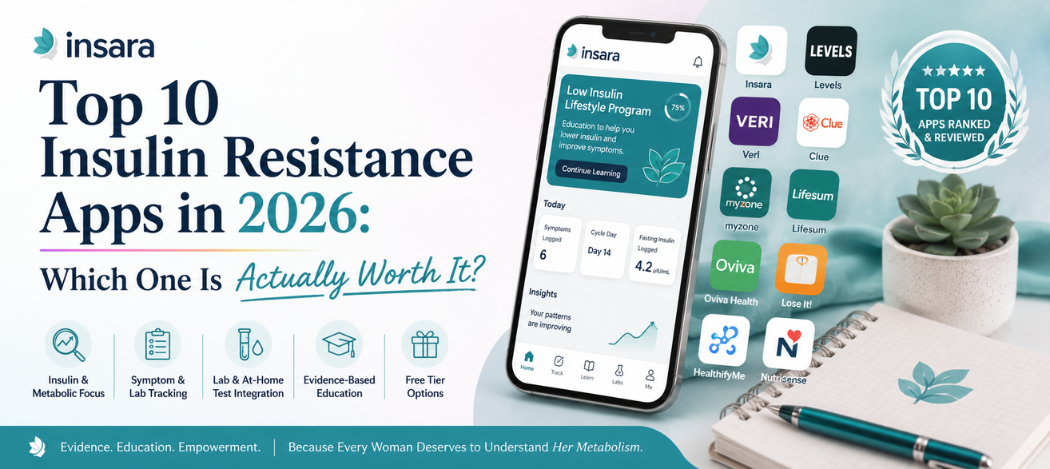
1. Insara — Best Overall for Insulin Resistance, Especially with PCOS
Insara is the only app built with insulin resistance as its central focus. Every feature in the app, from cycle tracking and symptom logging to the full Low Insulin Lifestyle education program, is designed around one thing: understanding and addressing elevated insulin.
The education modules are based on three published clinical studies, including a randomized controlled trial comparing the Low Insulin Lifestyle to standard care plus Metformin. In that trial, participants on the Low Insulin Lifestyle lost 17 pounds and dropped fasting insulin by 35% in eight weeks, without calorie counting or intensive exercise. The earlier pilot study showed a 52% drop in fasting insulin in the same timeframe.
More importantly, Insara integrates with the Insara Metabolic Kit, an at-home CLIA-certified panel that measures fasting insulin, HbA1c, high-sensitivity CRP, cholesterol, and triglycerides. You can track your actual numbers in the app over time and see whether your lifestyle changes are producing results.
No other app on this list connects education, lifestyle tracking, and laboratory measurement into one platform.
2. Levels — Best CGM Companion for Real-Time Glucose Tracking
Subscription required ($199+/year) | iOS and Android | levelshealth.com
Levels pairs with a continuous glucose monitor (CGM) to give you real-time data on how your blood sugar responds to food, exercise, stress, and sleep. For understanding the relationship between your diet and blood glucose, it is one of the most informative tools available.
However, Levels tracks glucose, not insulin. These are different measurements. You can have completely normal glucose with significantly elevated insulin, which is exactly the pattern in the early stages of insulin resistance. Levels will not show you that. It also costs significantly more than most apps due to the CGM requirement.
For women who have already addressed their fasting insulin and want to dial in their glucose response, Levels is excellent. For someone beginning to understand insulin resistance, starting with fasting insulin measurement is more informative.
Best for: Women who already have a handle on insulin education and want real-time blood glucose data.
3. Veri — Best for Metabolic Pattern Discovery via CGM
Subscription required | iOS and Android | veri.co
Veri is another CGM companion app that focuses on metabolic health, with a stronger emphasis on scoring and pattern recognition than Levels. It assigns a metabolic score based on your glucose patterns and gives specific recommendations for improving it.
Like Levels, Veri tracks glucose, not insulin, and requires a CGM subscription. The app’s focus on patterns over time rather than real-time data is genuinely useful for building habits, and the educational content is above average for a CGM app.
Best for: Women who want to build metabolic habits through glucose-pattern coaching alongside CGM use.
4. January AI — Best for AI-Driven Food and Glucose Prediction
Free basic / Premium | iOS and Android | january.ai
January AI uses an AI model to predict how specific foods will affect your blood glucose without a CGM, based on population data and your personal profile. The food database is extensive and the predictions are useful for identifying high-glucose foods in advance.
The limitation for insulin resistance specifically is that glucose predictions are not insulin predictions. A food that produces a moderate glucose response can still trigger a significant insulin response, particularly in people who already oversecrete insulin. The app does not account for this distinction.
Best for: Women who want AI-assisted guidance on food choices and do not have or want a CGM.
5. Ultrahuman Ring/App — Best Wearable for Metabolic Recovery Tracking
Wearable required ($349+) | iOS and Android | ultrahuman.com
Ultrahuman is a wearable ring that tracks sleep, recovery, heart rate variability, and metabolic health. The app pairs with the ring to give an overall metabolic score and identifies patterns in recovery, activity, and sleep that affect glucose regulation.
Like most CGM-adjacent apps, it does not directly measure insulin. But its focus on sleep and recovery metrics is genuinely relevant for insulin resistance management, since sleep disruption raises cortisol which in turn raises insulin. The wearable data is richer than most apps.
Best for: Women who want comprehensive wearable data alongside metabolic health tracking.
6. Cronometer — Best for Detailed Micronutrient Tracking
Free / Gold ($9.99/month) | iOS and Android | cronometer.com
Cronometer tracks calories, macros, and an unusually detailed micronutrient profile. For women with insulin resistance, certain micronutrients, including magnesium, vitamin D, and zinc, are particularly relevant, and Cronometer tracks all of them.
It does not have any insulin-specific education, does not explain the insulin response to different foods, and does not support fasting insulin logging. But for anyone who wants to ensure their nutritional foundation is solid alongside other insulin management strategies, it is the most detailed nutritional tracking app available.
Best for: Women who want granular micronutrient data as part of a broader insulin resistance management approach.
7. Carb Manager — Best for Low-Carb Dietary Tracking with IR Context
Free / Premium | iOS and Android | carbmanager.com
Carb Manager is popular among people following low-carb or ketogenic diets, and it includes some insulin resistance education in its premium content. The net carb tracking is accurate and the food database is extensive.
The limitation for PCOS specifically is that low carb is not the same as low insulin. Some low-carb foods, particularly whey protein, still produce significant insulin spikes. Carb Manager does not account for the insulin response to non-carbohydrate foods, which limits its utility for the PCOS population.
Best for: Women following a low-carbohydrate approach who want detailed carb tracking.
8. MyFitnessPal — Largest Database, Limited IR Value
Free / Premium ($19.99/month) | iOS and Android | myfitnesspal.com
MyFitnessPal has the largest food database of any tracking app and an enormous community. For general nutrition awareness, it works well. For insulin resistance management specifically, it tracks the wrong variables: calories and macros rather than insulin response.
As noted in the PCOS app list above, a calorie is not a useful unit for understanding your hormonal response to food. MyFitnessPal treats a 400-calorie serving of white rice identically to a 400-calorie serving of eggs and avocado. For insulin resistance, those two meals are not the same thing at all.
Best for: Women who want general nutritional awareness as a baseline alongside more insulin-specific education.
9. Heads Up Health — Best for Aggregating Multiple Lab and Device Data
Free / Premium | iOS and Android | headsuphealth.com
Heads Up Health is a health data aggregation platform that can pull data from wearables, CGMs, electronic health records, and manual lab entry. For women who are getting regular fasting insulin tests through their provider and want to track the trend over time, Heads Up gives a clear longitudinal view.
It is not a consumer-friendly, education-first product. It is a data aggregation tool for people who already know what they are tracking. But for organised health data management, it is genuinely useful.
Best for: Women who already have fasting insulin data from their provider and want to track trends over time.
10. Apple Health / Google Fit — Best as a Central Data Hub
Free | iOS / Android built-in
Apple Health and Google Fit do not offer insulin resistance education, but they function as useful central hubs for aggregating data from other apps and wearables. Both allow manual entry of fasting insulin values, which at minimum lets you create a trend record over time.
If you are using multiple apps and devices to manage insulin resistance, connecting them through Apple Health or Google Fit gives you one place to view the aggregate picture.
Best for: Aggregating data from multiple apps and devices into one place.
Insulin Resistance App Comparison Table
| App | Insulin Education | Fasting Insulin Tracking | Food-Insulin Connection | At-Home Test Integration | Free Tier |
|---|---|---|---|---|---|
| Insara | Yes — comprehensive | Yes | Yes — LIL(low-insulin lifestyle) framework | Yes — Metabolic Kit | Yes |
| Levels | Partial — glucose focus | No | Partial — glucose only | Requires CGM | No |
| Veri | Partial — glucose focus | No | Partial — glucose only | Requires CGM | No |
| January AI | Partial | No | Partial — AI glucose model | No | Yes (basic) |
| Ultrahuman | Partial — recovery focus | No | Partial | Requires wearable | No |
| Cronometer | No | No | No | No | Yes |
| Carb Manager | Partial | No | Partial — carbs only | No | Yes |
| MyFitnessPal | No | No | No | No | Yes |
| Heads Up Health | No | Yes (manual entry) | No | Aggregation only | Yes (basic) |
| Apple/Google Health | No | Yes (manual entry) | No | No | Yes |
The Bottom Line
Most apps in this space track glucose, track calories, or track steps. None of those measurements directly tells you what your insulin is doing, and insulin is what matters most for the majority of people with insulin resistance, especially women with PCOS/PMOS.
Insara is the only app that starts from insulin, builds a complete education program around it, and then connects that education to actual laboratory measurement so you can see whether your approach is working.
The CGM apps (Levels, Veri, Ultrahuman) are valuable for a different use case. The nutrition trackers (MyFitnessPal, Carb Manager, Cronometer) are useful supplements. But for someone starting out with insulin resistance management, or for anyone with PCOS looking for an app built specifically for their hormonal reality, Insara is where to begin.
Download the Insara App — Free
Test Your Fasting Insulin at Home — Insara Metabolic Kit
Frequently Asked Questions
Insara is the only app built specifically to track and educate on insulin resistance, with integration for at-home fasting insulin testing via the Insara Metabolic Kit. For glucose tracking alongside a CGM, Levels and Veri are the strongest options.
Apps are education and tracking tools, not treatments. However, education-based apps like Insara can meaningfully support behaviour change, and the three clinical studies behind the Low Insulin Lifestyle show that the dietary approach Insara teaches can reduce fasting insulin by 35 to 52% in eight weeks without medication.
Most apps do not directly support fasting insulin logging. Insara does, and integrates with the Insara Metabolic Kit for at-home testing. Heads Up Health and Apple Health allow manual entry if you have results from a provider.
A continuous glucose monitor tracks blood sugar in real time, which is useful information. However, glucose and insulin are different measurements. In early insulin resistance, glucose can be completely normal while insulin is already elevated. Starting with fasting insulin testing is generally more informative than starting with a CGM.
Glucose reflects the level of sugar in your blood. Insulin reflects how hard your pancreas is working to manage that sugar. In early insulin resistance, glucose is often normal because the pancreas is compensating with higher insulin output. This is why fasting insulin tells you something a glucose reading cannot.
Yes, particularly Insara, which was designed specifically with PCOS/PMOS and its metabolic root cause in mind. The three clinical studies behind the Low Insulin Lifestyle focused specifically on women with PCOS, and the app’s education and tracking features reflect that research directly.
The Insara App is free to download. Premium features are available with a subscription. The Insara Metabolic Kit is a separate purchase and provides at-home CLIA-certified fasting insulin testing with results delivered in the app.
This article is for educational purposes only. It does not constitute medical advice, diagnosis, or treatment. Always consult a qualified healthcare provider about your health decisions.