What Is Insulin Resistance?

Insulin resistance happens when your body stops responding to insulin as well as it should. Over time, this can affect your weight, hormones, energy, and long-term health.

How Insulin Resistance Shows Up in Your Body

When your cells stop responding to insulin, your body has to produce more of it to keep things balanced. Over time, this can disrupt hormones, make it harder to manage weight, and leave you feeling low on energy.


It does not just affect one part of your health. It can show up in your metabolism, mood, skin, and overall well-being.

What You'll Learn with Insara

What Is Insulin Resistance?

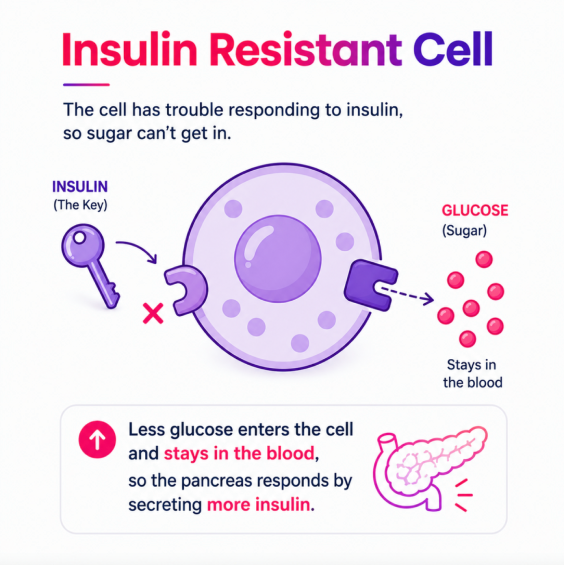
Insulin resistance happens when your cells stop responding properly to insulin, the hormone that helps move sugar from your blood into your cells.


To compensate, your body produces more insulin. Over time, this can lead to weight gain, constant fatigue, cravings, and inflammation.


The tricky part is that it often goes unnoticed. Your blood sugar can still look normal, even while insulin levels stay elevated in the background.
Most people do not realize they are insulin resistant until symptoms start to build. This is why so many women feel like they are doing everything right, but nothing is working.

What Causes Insulin Resistance?

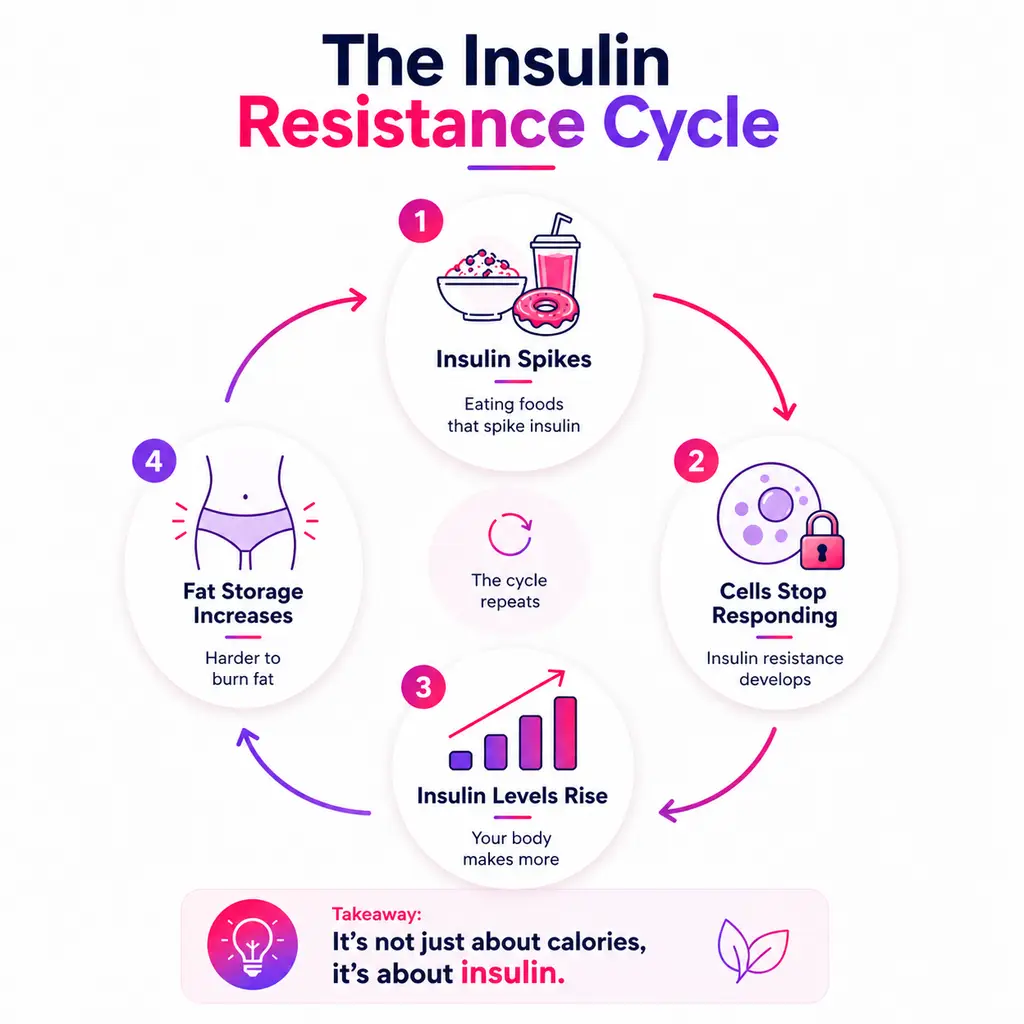
Every time you eat, your body releases insulin to help move sugar into your cells.


But certain foods and habits cause bigger insulin spikes than others. Over time, these frequent spikes can overwhelm your system. Your cells start to become less responsive to insulin. This is often called “insulin resistance.”
When that happens, your body has to produce more and more insulin to get the same effect. Over time, this leads to consistently higher insulin levels in the background. And that is what starts to affect your metabolism, hormones, and overall health.

Why Diets Don't Work

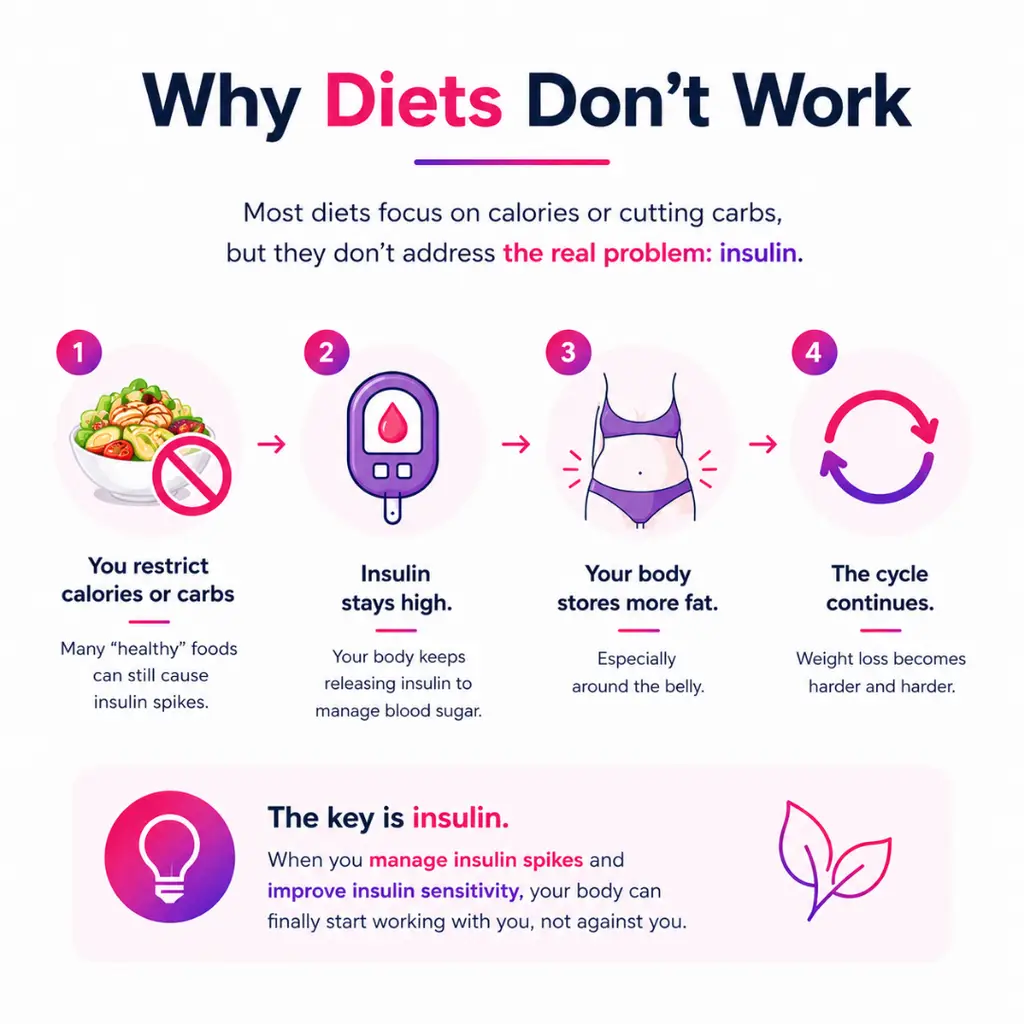
Most diets focus on calories or blood sugar, not insulin. They tell you to eat less or cut carbs. But they often ignore what is actually driving weight gain and hormone imbalance. Even carb restriction alone is not always the answer. Because it is not just about what you eat, but how your body responds to it.


If insulin levels stay high, your body is more likely to store fat and less able to burn it. That means even when you are doing everything “right,” results can feel slow or inconsistent. This is why so many diets work at first, but are hard to sustain. They do not address the underlying signal telling your body what to do with energy.


When you focus on insulin, your body can start working with you instead of against you.

  • High Fiber
  • Walk Daily
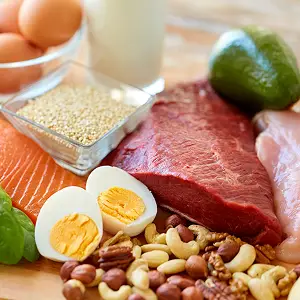
  • Whole Proteins
  • Stay Hydrated
  • Sleep Hygiene
  • Treat Yourself
  • Move Often
  • Manage Stress
  • Healthy Fats
  • Lift Weights

Our References

Frame
Frame

References

Abdul-Ghani, M. & DeFronzo, R. A. Insulin Resistance and Hyperinsulinemia: The Egg and the Chicken. Journal of Clinical Endocrinology and Metabolism vol. 106. Preprint at https://doi.org/10.1210/clinem/dgaa364 (2021).


Dankner, R., Chetrit, A., Shanik, M. H., Raz, I. & Roth, J. Basal-state hyperinsulinemia in healthy normoglycemic adults is predictive of type 2 diabetes over a 24-year follow-up: A preliminary report. Diabetes Care 32 (2009).


Erion, K. A. & Corkey, B. E. Hyperinsulinemia: a Cause of Obesity? Current Obesity Reports vol. 6. Preprint at https://doi.org/10.1007/s13679-017-0261-z (2017).


Guess, N. et al. Hyperinsulinaemia as a cause of obesity and cardiometabolic diseases. Nat Rev Endocrinol. (2026).

doi:10.1038/s41574-026-01240-1.
Houston, E. J. & Templeman, N. M. Reappraising the relationship between hyperinsulinemia and insulin resistance in PCOS. J. Endocrinol. 265 (2025).


Janssen, J. A. M. J. L. Hyperinsulinemia and its pivotal role in aging, obesity, type 2 diabetes, cardiovascular disease and cancer. International Journal of Molecular Sciences vol. 22. Preprint at https://doi.org/10.3390/ijms22157797 (2021).


Page, M. M. & Johnson, J. D. Mild Suppression of Hyperinsulinemia to Treat Obesity and Insulin Resistance. Trends in Endocrinology and Metabolism vol. 29. Preprint at https://doi.org/10.1016/j.tem.2018.03.018 (2018).


Shanik, M. H. et al. Insulin resistance and hyperinsulinemia: is hyperinsulinemia the cart or the horse? Diabetes Care vol. 31 Suppl 2. Preprint at https://doi.org/10.2337/dc08-s264 (2008).


Thomas, D. D., Corkey, B. E., Istfan, N. W. & Apovian, C. M. Hyperinsulinemia: An early indicator of metabolic dysfunction. Journal of the Endocrine Society vol. 3, 1727–1747. Preprint at https://doi.org/10.1210/js.2019-00065 (2019).


Zhang, A. M. Y., Wellberg, E. A., Kopp, J. L. & Johnson, J. D. Hyperinsulinemia in obesity, inflammation, and cancer. Diabetes and Metabolism Journal vol. 45, 285–311. Preprint at https://doi.org/10.4093/DMJ.2020.0250 (2021).

Frequently Asked
Questions

Is it possible to have insulin resistant if my glucose or A1c is normal?
Yes—insulin resistance can exist even when glucose and A1c are normal. These markers often stay normal for years while insulin is already elevated and your pancreas is working harder behind the scenes.
Many people with elevated insulin have normal glucose and A1c levels, so it often goes undetected. Common signs can include weight gain (especially around the abdomen), fatigue, sugar cravings, irregular cycles, acne, or difficulty losing weight. The most accurate way to know is by measuring your fasting insulin level.

No—insulin resistance often develops years before diabetes. It means your body is producing more insulin to keep blood sugar normal, which is why it can go unnoticed early on.

Your fasting insulin level should be below 8 mIU/mL. This range is typically significantly lower than what is considered “normal” by standard laboratory references.

Most traditional care focuses on glucose and A1c, not insulin. Insulin is not routinely tested even though it can be elevated years earlier.

Because most traditional approaches focus on measuring markers like glucose or A1C, or managing symptoms like weight and cycles. Insulin itself is rarely measured or addressed directly, even though it plays a central role in PCOS for many women.

Yes—insulin resistance can often be improved and even reversed by lowering insulin levels over time. With a Low Insulin Lifestyle, many people see improvements in weight, energy, hormones, and overall metabolic health.