

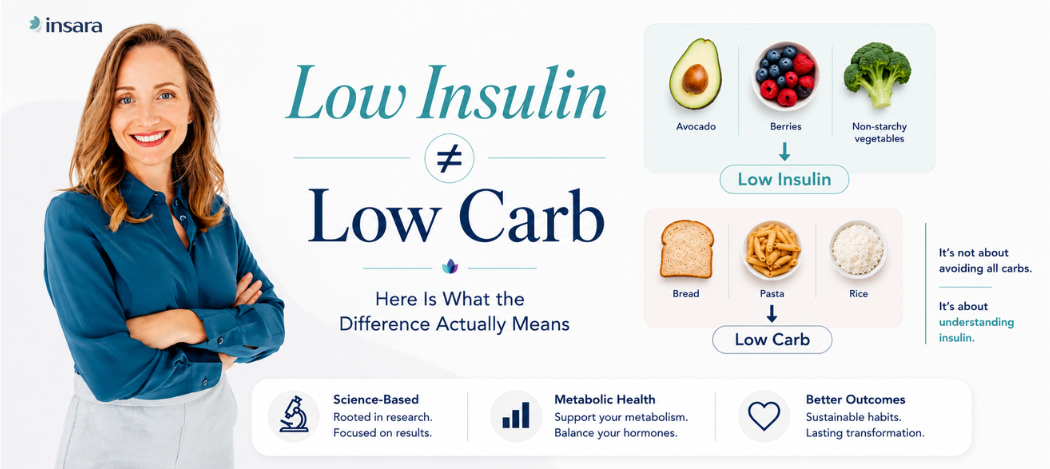
This is one of the questions I get asked more than almost any other.
“What is the difference between a Low Insulin Lifestyle and a low carb diet? Aren’t they the same thing?”
I understand why people ask. On the surface, it seems like they should be the same. Carbs raise blood sugar, blood sugar triggers insulin, so cutting carbs should mean cutting insulin, right?
Not quite. And the gap between those two ideas is exactly where a lot of women with PCOS/PMOS end up frustrated, confused, and convinced they are doing everything “right” while still not seeing results.
So let’s break this down properly, because once this clicks, it changes how you look at food completely.
The Short Answer
A Low Insulin Lifestyle and a low carb diet are not the same thing, for two main reasons.
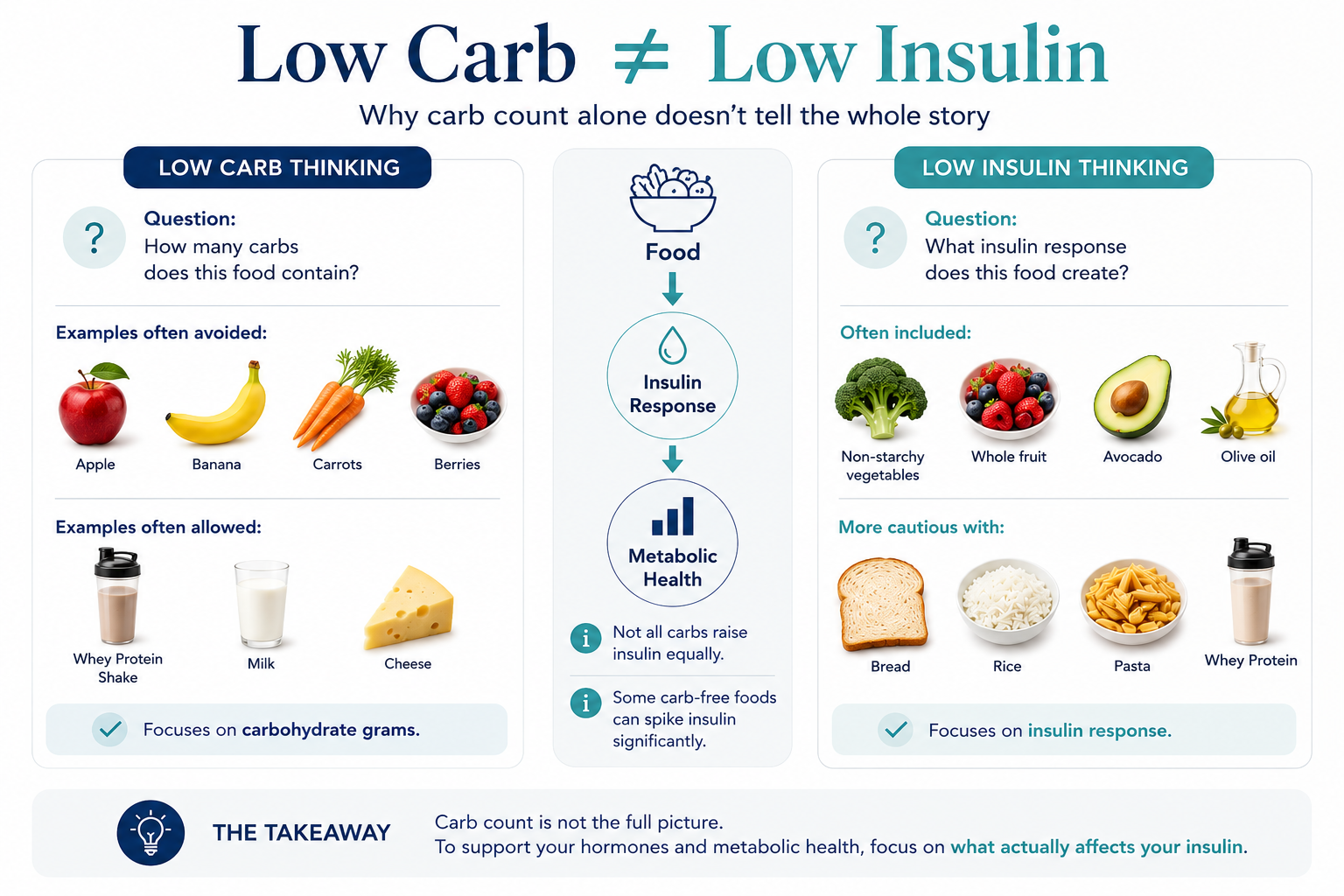
First, not all carbohydrates spike insulin the same way. Some carbs cause a large insulin response. Others barely move the needle at all. It depends on how much glucose they have.
Second, some foods with zero carbohydrates can spike insulin more than many carb-containing foods do. Whey protein is actually one of the most insulin-spiking foods you can eat, and it does not contain any carbohydrates at all.
This means a diet built purely around “low carb” can miss the mark in both directions. It can cut out foods that were never the problem, and it can leave in foods that are quietly driving the exact insulin response you are trying to avoid.
Not All Carbs Are Created Equal
Here is the part that surprises most people.
When we talk about carbohydrates causing an insulin response, we are really talking about a spectrum, not a single category.
Starches and sugars sit at the high end of that spectrum. Bread, pasta, rice, potatoes, crackers, beans, cereal, and sugary foods and drinks all break down into glucose, and your body responds with a significant insulin release to manage it. This is true even when these foods do not taste sweet. A slice of white bread and a spoonful of sugar can produce a remarkably similar insulin response.
Certain types of dairy are also high on that spectrum
Milk is technically a carbohydrate-containing food because it contains lactose, but its insulin response does not always match its glycemic response. That is because milk naturally contains insulin and a growth signaling hormone called insulin-like growth factor 1, or IGF-1. In nature, this makes sense. The purpose of milk is to help a newborn baby or calf grow, store fat, and develop quickly. So when you drink milk, you are not just consuming a food with carbohydrates. You are consuming a growth-promoting food that can stimulate insulin and IGF-1 activity, even though it contains very little glucose. This is why milk can create a much larger insulin response than its glycemic response would suggest.
Non-starchy vegetables and whole fruits sit at the much lower end of that spectrum. Non-starchy vegetables are naturally low in glucose and rich in fiber, making them some of the lowest insulin stimulating carbohydrate foods available. Whole fruits are different because a portion of their carbohydrate comes from fructose (which is not the same thing as high fructose corn syrup). Unlike glucose, fructose does not require insulin for metabolism. While excessive fructose intake can become problematic when it overwhelms the liver, the amount found in whole fruit is relatively modest and comes packaged with fiber and water. As a result, non-starchy vegetables and whole fruits generally produce a much gentler insulin response than starches and sugars, even though they are technically carbohydrates.
This is why a blanket “cut all carbs” approach does not match what is actually happening in your body. If you are avoiding kiwis and carrots with the same intensity you avoid white bread and rice, you are treating two very different foods as if they were identical, when your insulin response to them is anything but.
The Part Nobody Talks About: Carb-Free Foods That Spike Insulin
This is the piece that genuinely surprises most people, and it is the reason “low carb” and “low insulin” can lead you to completely different places.
Whey protein has essentially zero carbohydrates, and it is one of the most insulin-spiking foods that exists.
I know how counterintuitive that sounds. Whey protein is marketed as a clean, “good for you,” muscle-building staple. It is in protein shakes, protein bars, protein pancakes, and countless “healthy” products. And from a pure carb-counting perspective, it looks completely harmless.
But your body does not only respond to carbohydrates with insulin. Protein triggers an insulin response too, and in many cases that is exactly what you want. Protein-induced insulin release helps shuttle amino acids into muscle cells, supporting muscle repair, recovery, and growth.
Much of this insulin response comes from a group of amino acids called branched-chain amino acids (BCAAs), particularly leucine. Leucine is one of the most powerful nutritional signals for muscle protein synthesis, which is why protein-rich foods naturally stimulate some insulin release.
The problem is not that whey protein stimulates insulin. The problem is the dose.
Whey is naturally the most leucine-rich protein source available because its biological purpose is to support growth during the most rapid phase of development: infancy. Nature tightly regulates this exposure. In a cup of milk, only about 2 grams of protein come from whey. The rest is primarily casein.
Modern whey protein powders completely bypass that natural regulation. During cheese and yogurt production, whey is separated from the milk. What was once considered a waste product is now filtered, concentrated, dried, and sold as whey protein powder. A single scoop of whey protein can contain roughly 25 grams of whey protein, equivalent to the amount of whey found in more than 10 cups (2.7 liters) of milk.
This creates a level of exposure to leucine and insulin-stimulating proteins that humans would rarely, if ever, encounter naturally.
This is not a reason to fear all protein. Protein is essential, and it plays a major role in a Low Insulin Lifestyle. But it does mean that “zero carbs” does not automatically mean “low insulin impact,” and whey protein is the clearest example of where those two ideas diverge.
However, not all dairy products have the same insulin response.
Casein-rich dairy products that undergo fermentation, such as Greek yogurt and aged cheeses, tend to produce a more moderate insulin response than milk or whey protein. First, much of the whey is removed during the production of Greek yogurt and cheese, reducing exposure to the most insulin-stimulating proteins. Second, the fermentation process alters the protein structure and converts some BCAAs into branched-chain keto acids (BCKAs), which appear to have a less pronounced effect on insulin secretion.
As a result, fermented dairy products often retain the nutritional benefits of dairy, including protein, calcium, and other micronutrients, while producing a lower insulin response than milk or whey protein powders. This is one reason why foods such as plain full-fat Greek yogurt and aged cheeses can fit well within a Low Insulin Lifestyle, whereas liquid milk, non-fermented dairy, and concentrated whey protein products may be less ideal choices for individuals trying to minimize insulin exposure.
So What Does This Mean for How You Eat?
This is the most important part, so let me be direct about it.
You do not have to cut out all your carbohydrates. You have to be smart about where those carbohydrates are coming from, and you have to look beyond carbohydrates entirely when it comes to insulin.
In practice, that looks like:
Being more mindful of starches and added sugars, since these tend to produce the largest and most sustained insulin responses. This includes foods that do not taste sweet, like bread, rice, beans, and pasta, as well as obvious sources like soda and desserts. Don’t forget that natural sugars are still sugar; this includes honey, maple syrup, and coconut sugar.
Not being afraid of non-starchy vegetables and most fruit, because their insulin impact is much smaller than their “carb” label might suggest, and they bring fiber, micronutrients, and satiety that genuinely support a low insulin approach.
Paying attention to dairy and protein sources, particularly whey protein, since these can have an outsized insulin effect that has nothing to do with carbohydrate content. This does not mean cutting out all dairy or protein. It means being selective.
This is the core difference. A low carb diet asks “how many grams of carbohydrate is in this?” A Low Insulin Lifestyle asks “what is this food actually doing to my insulin?” Sometimes those questions have the same answer. Often, they do not.
Why This Distinction Matters So Much for PCOS/PMOS
If you have PCOS/PMOS, this distinction is not just academic. It can be the difference between a way of eating that feels sustainable and one that feels like a constant uphill battle.
Up to 95% of women with PCOS/PMOS have some degree of insulin resistance. When insulin stays elevated, your body stays in fat storage mode, your hormones stay out of balance, and symptoms like irregular cycles, acne, excess hair growth, and stubborn weight gain tend to persist no matter how hard you are trying.
A strict low carb or keto approach can genuinely help some women, largely because it reduces the starches and sugars that drive the biggest insulin spikes. But if that same approach leads someone to eliminate fruit and vegetables out of fear, while continuing to rely heavily on whey protein shakes, milk, and processed “low carb” products, the insulin picture may not improve nearly as much as the carb count would suggest. In some cases, it can even work against you.
This is also why so many women tell us they did “everything right” on a low carb plan and still did not see the changes they expected in their cycles, their skin, or their weight. It is rarely about willpower. It is almost always about which foods were actually driving the insulin response, regardless of their carbohydrate content.
The Bottom Line
Low carb and low insulin overlap, but they are not interchangeable.
Reducing starches and added sugars is genuinely one of the most effective things you can do to lower insulin. But the goal is not the absence of carbohydrates. The goal is understanding which foods, carb-containing or not, are driving your insulin response, and making informed choices from there.
That is the entire foundation of a Low Insulin Lifestyle, and it is what 15 years of our research has been built around.
Want to Understand This Better?
If this raised more questions than it answered, that is completely normal. This single concept, the difference between low carb and low insulin, is one of the most important shifts in how to think about food with PCOS/PMOS, and it deserves more than a few paragraphs.
Learn more about the Low Insulin Lifestyle and the research behind it
Tools to Support Your Low Insulin Lifestyle
Understanding the difference between low carb and low insulin is the first step. Here is where to go next.
Test Your Insulin at Home The Insara Metabolic Kit measures fasting insulin, HbA1c, inflammation, cholesterol, and triglycerides from a single finger prick. CLIA certified lab accuracy. Results in your Insara App within 3 to 7 days. No lab visit. No prescription.
→ Shop the Insulin Testing Kit
Track Your Progress with the Insara App Free to download. Log your symptoms, cycle, mood, lab results, and Low Insulin Lifestyle journey, all in one place, with plain English guidance at every step.
→ Download the Insara App
Understand the Low Insulin Lifestyle Our science backed books explain how different foods affect insulin, why calorie counting and carb counting alone fall short for PCOS/PMOS, and how to start building meals that actually work for your hormones.
→ Explore the Books
Read the Research Three published clinical studies, including a randomized controlled trial, showing what happens when women lower their insulin: up to 52% reduction in fasting insulin, 19 lbs average weight loss, and improved hormonal markers, all in 8 weeks.
→ View Our Research
Frequently Asked Questions About Low Insulin vs Low Carb
Low carb eating can help insulin resistance, mainly because it reduces starches and added sugars, which are among the biggest drivers of insulin spikes. However, “low carb” is not the same as “low insulin.” Some low carb staples, especially whey protein and certain dairy products, can still trigger a strong insulin response even though they contain little or no carbohydrate. A low insulin approach looks at the full picture, not just carbohydrate grams.
You do not need to go keto to improve insulin resistance. Research shows that reducing foods with the largest insulin response can meaningfully improve insulin sensitivity without requiring the very low-carbohydrate intake that keto demands. For many women with PCOS/PMOS, a moderate approach that is selective about starches and sugars, while still including non-starchy vegetables and fruit, is more sustainable long term than strict keto.
A low carb diet focuses on reducing total carbohydrate intake, regardless of the source. A Low Insulin Lifestyle focuses on the actual insulin response a food produces, which depends on more than carbohydrate content alone. This means a Low Insulin Lifestyle may include foods a strict low carb diet would avoid, like fruit and certain whole grains in moderation, while being more cautious about foods a low carb diet might allow freely, like whey protein and some dairy products.
Yes. Most whole fruits have a much smaller impact on insulin than starches and added sugars. This is partly because some of the carbohydrate in fruit comes from fructose, which does not require insulin for metabolism. Combined with the fiber and water naturally found in fruit, this results in a much gentler insulin response than foods like bread, rice, pasta, potatoes, and sugary drinks.
For most women with PCOS/PMOS, whole fruit does not need to be feared or avoided.
Insulin is not only released in response to carbohydrates. Protein, and whey protein in particular, directly stimulates the pancreas to release insulin, independent of carbohydrate content. This is sometimes called an insulinogenic effect. Whey protein is considered one of the most insulin-spiking foods available, despite containing essentially zero carbohydrates. This does not make whey protein “bad,” but it does mean it should be considered when thinking about overall insulin response, not just carb counts.
It depends on the type. Milk and whey-based products tend to have a larger impact on insulin, partly due to naturally occurring insulin and insulin-like growth factor 1 (IGF-1), as well as their whey protein content. Greek yogurt and aged cheeses tend to have a much smaller impact. The goal is not to be dairy-free, but to be selective about which dairy products you rely on most often.
This is one of the most common frustrations we hear, and it often comes back to the distinction between low carb and low insulin. If a low carb plan still relies heavily on whey protein shakes, certain dairy products, or other foods with a significant insulin response, insulin may remain elevated even while carbohydrate intake is low. Since insulin is the hormone most directly tied to fat storage, this can explain why the scale does not move as expected, even when someone is genuinely following their plan.
The foods most strongly associated with raising insulin are refined starches (white bread, pasta, rice, crackers) and added sugars, including “natural” sugars like honey, maple syrup, and agave. Beyond carbohydrates, whey protein and certain dairy products, particularly milk and whey-based items, can also have a significant insulin impact. The goal is not to eliminate entire food groups, but to be intentional about how often these specific foods appear in your diet.
There is no single “best” diet that works identically for everyone, but the most effective approaches share one thing in common: they reduce the foods that drive the largest insulin responses, primarily refined starches, added sugars, and certain high-insulin dairy and protein sources, while still allowing non-starchy vegetables, fruit, and a wide range of whole foods. This is the foundation of what we call a Low Insulin Lifestyle, and it is the approach our research has focused on for the past 15 years.
Insulin is the hormone that largely determines whether your body stores fat or accesses it for energy. When insulin stays elevated, your body tends to stay in fat storage mode, which can make weight loss feel disproportionately difficult, even with consistent effort. Lowering insulin does not guarantee weight loss on its own, but it removes one of the biggest barriers many women with PCOS/PMOS face, which is why our research has focused on insulin rather than calories or carbohydrates alone.