

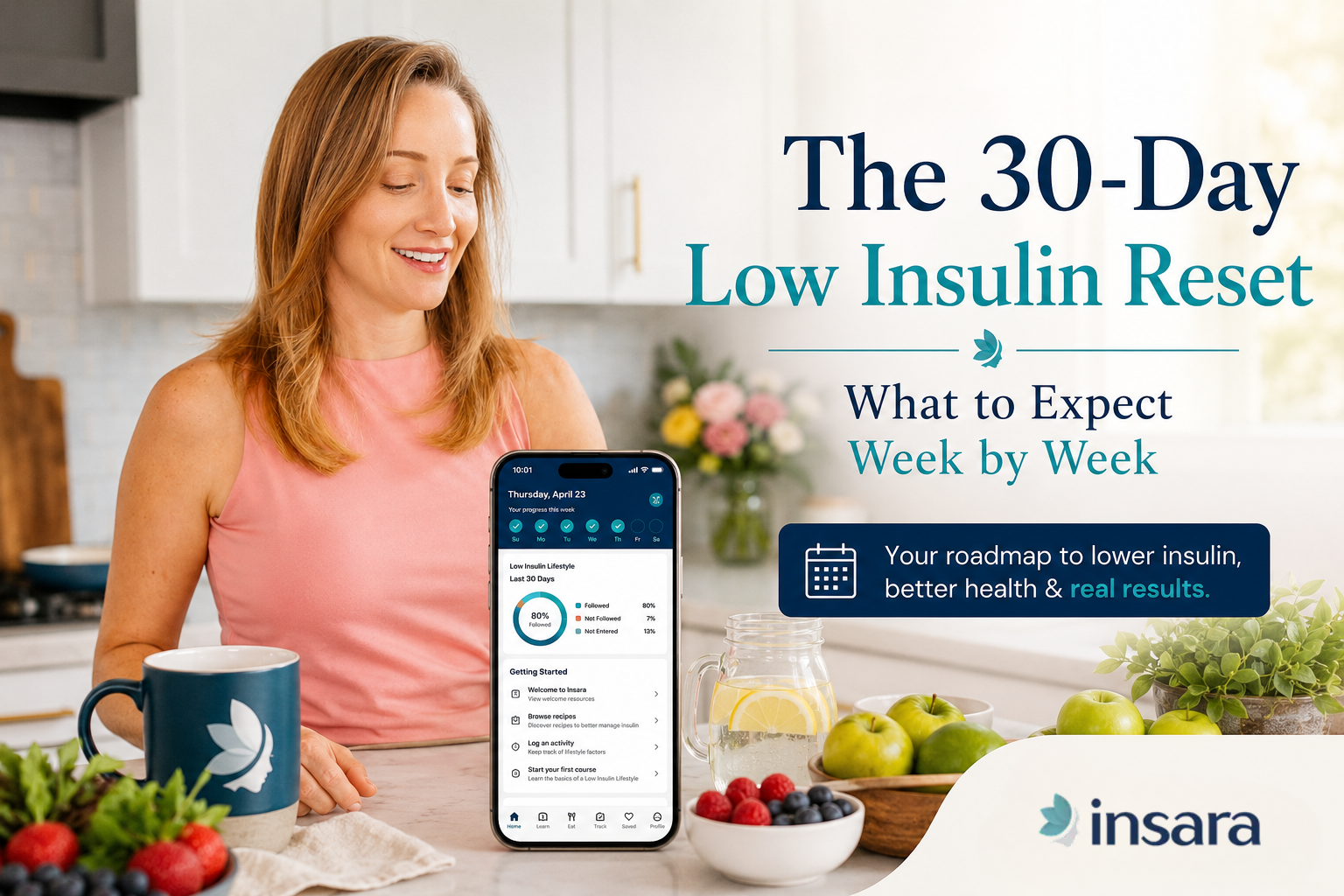
Starting the Low Insulin Lifestyle is one thing. Knowing what to actually expect from it is another.
Most women who come to Insara have already tried something. They have counted calories, cut carbs, done 30-day challenges, and followed plans that promised results by day 21. And most of them felt like they failed when their body did not cooperate on the expected timeline.
I want to give you something different: an honest, week-by-week picture of what actually happens when you start lowering insulin, based on the research I have spent 15 years doing and the patterns I have seen consistently across hundreds of women with PCOS/PMOS and insulin resistance.
This is not a rigid meal plan. It is not a challenge with rules you can break. It is a roadmap of what your body is likely doing in each phase of the first 30 days, so you know what is normal, what is progress, and what to do when it feels like nothing is happening.
Before you dive in, one important note. The most useful thing you can do alongside this reset is know your starting point. If you have not tested your fasting insulin, HbA1c, and inflammation markers, you are measuring progress without a baseline. The Insara Metabolic Kit gives you that baseline from a single finger-prick sample at home, with results in the Insara App within 3 to 7 days.
Get your baseline before you start
Before Day 1: Set Your Foundation
A reset does not start on day one. It starts with preparation.
Know your numbers. Fasting insulin, HbA1c, and a full metabolic panel give you a before picture to measure against. Many women are genuinely shocked by what their fasting insulin is before they start. That number is your baseline, and it is what you are working to move.
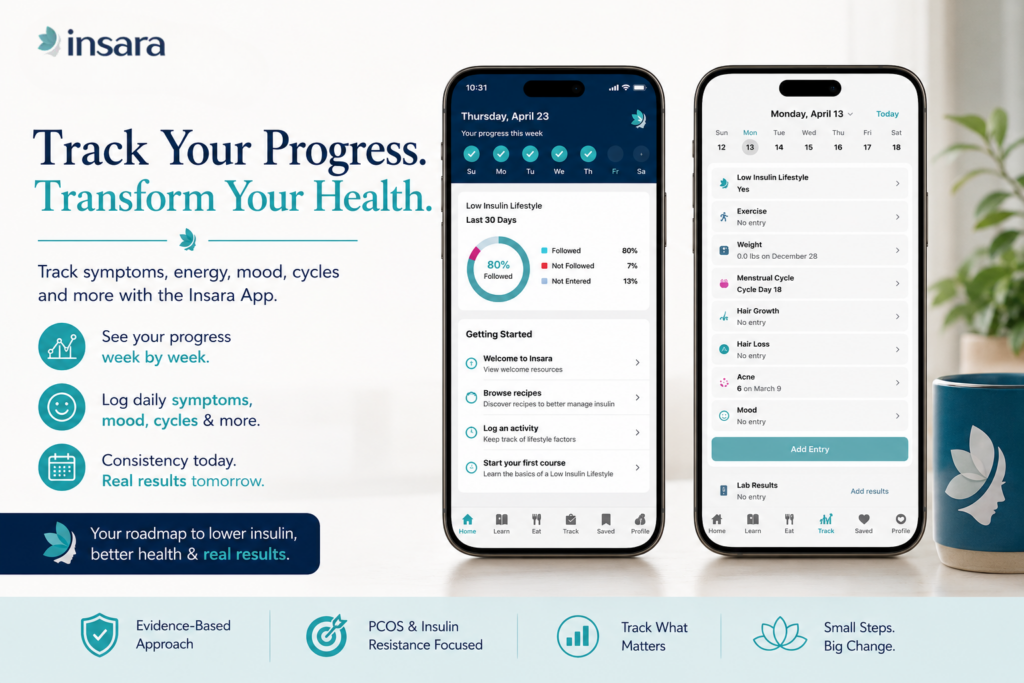
Download the Insara App. The app is where you will track your symptoms, mood, adherence, and any lab results throughout the reset. Tracking is not about judgment. It is about pattern recognition. Women who track consistently see their own patterns far more clearly than those who rely on memory, and patterns are where the insights live.
Clear the highest-insulin foods from your kitchen. You do not have to be perfect on day one. But making it easier to make better choices is half the work. Stock protein, eggs, non-starchy vegetables, healthy fats, nuts, berries, and Greek yogurt. Move the bread, crackers, and sweetened drinks to the back, or out entirely.
Read the Low Insulin Lifestyle foundations. The goal is not to restrict, it is to understand. When you know why certain foods spike insulin and others do not, the choices start to feel intuitive rather than effortful.
Week 1 (Days 1 to 7): Your Body Is Adjusting
What is happening: You are removing the foods that have been producing your largest insulin spikes, often multiple times a day. Your body is adjusting to a different pattern of fuel and insulin signaling. This adjustment is real, and it can feel uncomfortable before it feels better.
What you will likely experience:
Cravings, and a lot of them. If you have been eating refined starches and added sugars regularly, week one often brings strong cravings as your body signals for the quick fuel source it is used to. This is not a sign that your body needs those foods. It is a sign that your insulin and hunger hormones are recalibrating. The cravings are loudest when the change is most needed.
Low energy or brain fog. Some women feel tired, sluggish, or mentally foggy in the first few days. This is a common and temporary response to the shift in how your body is sourcing energy. It typically resolves by the end of day two or three.
More hunger than expected. This often surprises people. You may feel hungry more often in week one, even when eating plenty. This is partly because the Low Insulin Lifestyle removes foods that are calorie-dense but unsatisfying from a hormonal standpoint. As insulin starts to drop, hunger-regulating hormones begin to normalise. Eating more healthy fat in week one helps significantly.
What is actually working in the background: Even when you cannot feel it yet, the insulin response to each meal is already lower than it was a week ago. Every meal that does not spike insulin is a step in the right direction.
What to do this week:
- Go meal by meal. Start with breakfast. Make sure your first meal of the day is high in protein, fiber, and healthy fat. Make sure it contains no refined starches or added sugar. Once breakfast feels right, move on.
- Eat enough. Undereating is one of the most common mistakes in week one. If you are hungry, eat more healthy fat or protein, and more fiber. Do not restrict calories at this stage.
- Use the Insara App to track adherence. You are building data, not grading yourself.
- Drink more water. Your body may be releasing stored glycogen in the first days, which releases water with it. Staying hydrated helps reduce fatigue and headaches.
What is normal: Feeling worse before you feel better. If day three is harder than day one, that is completely expected. Do not stop.
Week 2 (Days 8 to 14): The Shift Begins
What is happening: By week two, your insulin levels are lower than they were when you started. Not dramatically lower yet, but measurably lower. And as insulin drops, the hormonal landscape around it begins to shift.
What you will likely experience:
Cravings ease noticeably. This is usually the first thing women notice in week two and it genuinely surprises most of them. The constant pull toward sweet or starchy foods starts to quiet. It does not disappear entirely, but it is no longer in the foreground of every meal decision.
Energy begins to stabilise. The fluctuating energy of week one, the mid-afternoon crashes, the sluggish mornings, start to level out. Lower insulin means more consistent energy.
Bloating often reduces. Many women with PCOS/PMOS experience chronic low-grade bloating related to inflammation and insulin. As insulin and inflammation markers begin to drop, this often noticeably improves in week two.
Better sleep in some women. Elevated insulin disrupts sleep architecture in ways that are not always obvious until it improves. Some women notice they fall asleep faster or wake less often in week two.
What is actually working: Insulin is dropping. Insulin sensitivity, the measure of how sensitive your cells are to insulin, is improving. Inflammation is beginning to decrease. These changes are not yet visible on the outside for most women, but they are measurable.
What to do this week:
- Add a walk after your largest meal of the day. Even 10 to 15 minutes significantly reduces the postprandial insulin response. This is one of the highest-impact, lowest-effort changes you can make.
- Keep tracking adherence in the Insara App. Patterns are emerging that will matter at week four.
- If you have not already, read the food guidance in the Insara App’s education modules. Week two is when most women start asking “but what about this food?” The modules answer those questions with specifics.
- Do not weigh yourself daily. The scale in week two can be misleading as your body adjusts water balance. Weekly measurements give a more accurate picture.
What is normal: Feeling better, but not dramatically better. Week two is a transition week. The major changes come in weeks three and four.
Week 3 (Days 15 to 21): Things Start to Show Up
What is happening: By the end of week three, the changes that have been building biochemically start to become visible and felt. This is the week most women have their first “wait, something is actually different” moment.
What you will likely experience:
Skin changes. For women with PCOS-related acne, skin often begins to improve around week three. Elevated insulin drives androgen production, which drives sebaceous activity. As insulin drops, the androgen signal quiets, and inflammatory skin changes often follow. This is not instant, and it is not universal, but week three is typically when it starts.
A noticeable shift in hunger patterns. By week three, most women report eating less simply because they are less hungry. Not because they are restricting, but because insulin-driven appetite is quieter. This is not willpower. This is your hunger hormones working the way they are supposed to.
Clothes fitting differently. Even if the scale has not moved dramatically, women often notice that clothes fit differently by week three. This is partly water retention reducing, and partly a shift in how fat is being stored and accessed in the body as insulin drops.
Mood stabilisation. The relationship between insulin and mood is real and often underacknowledged. Insulin dysregulation contributes to mood swings, irritability, and anxiety. As insulin steadies, mood tends to follow.
What is actually working: Fasting insulin is continuing to drop. In my clinical studies, meaningful reductions in fasting insulin and HOMA-IR were observed within 8 weeks, and the trajectory in week three is moving steadily in that direction. Free testosterone, which is directly driven by insulin in the PCOS/PMOS pathway, is also beginning to reduce.
What to do this week:
- Stay consistent with the food approach. Week three is when some women start to relax and allow exceptions to creep back in. The body is responsive enough at this stage that inconsistency is more disruptive than it was in week one.
- Add resistance training if you have not already. Three sessions per week of weighted exercises builds muscle that acts as a metabolic sponge for glucose, improving insulin sensitivity directly. This is not about burning calories. It is about building tissue that reduces insulin demand.
- Check in with the Insara App’s education modules. By week three, most women are ready for a deeper understanding of specific food categories: dairy, protein, fats, etc.
- Consider how sleep and stress are affecting your results. Cortisol and insulin are tightly linked. Chronic stress and poor sleep keep insulin elevated independently of diet. If these are a factor, the Insara App’s mood tracking will start to show the pattern.
What is normal: Feeling genuinely better. Some women feel dramatically better. Others feel incrementally better. Both are real progress.
Week 4 (Days 22 to 30): The New Normal
What is happening: By week four, the Low Insulin Lifestyle is no longer a “reset.” It is becoming the way you eat. The food choices that felt restrictive in week one are starting to feel normal. And the way your body responds to food, to stress, to sleep, is measurably different from where you started.
What you will likely experience:
Stable energy throughout the day. The symptoms of elevated insulin that many women with PCOS/PMOS do not even realize they are riding, the crash at 3pm, the desperate need for something sweet after dinner, are significantly calmer by week four. Energy is more even, more predictable, more sustainable.
Improved cycle regularity in some women. This will not happen for everyone in 30 days, and the timeline varies significantly depending on starting insulin levels and individual biology. But some women notice early cycle changes in week four. When insulin drops enough, the LH/FSH signalling that drives ovulation can begin to normalise.
Real changes in body composition. Weight loss is possible in 30 days, but body composition changes, meaning actual fat loss and reduced visceral fat, are more meaningful and often more visible. In my 8-week clinical study, women lost an average of 19 lbs. The first 30 days are the foundation of that trajectory.
A different relationship with food. This is the change that surprises most women most. Food starts to feel less like a battle. Less like restriction. More like information. When you understand what different foods do to your insulin, the choices become clearer and less emotionally charged.
What is actually working: Fasting insulin is lower than day one. HOMA-IR has improved. Inflammation markers are moving in the right direction. Free testosterone is dropping. These are the same markers that showed 53% reductions in fasting insulin, 23% reductions in free testosterone, and 35% drops in triglycerides in my 8-week clinical research, and day 30 puts you squarely on that trajectory.
What to do this week:
- Retest your fasting insulin, HbA1c, and metabolic markers. You need a second data point to see what has actually moved. If you used the Insara Metabolic Kit at the start, week four or five is the right time to retest. Seeing the numbers move is more motivating than anything else.
- Review your Insara App tracking from the past 30 days. What patterns show up? What days were harder? What meals left you most satisfied? This data is yours and it is more useful than any general advice.
- Set your focus for the next 30 days. A 30-day reset is a start. The most significant changes in my research appeared at 8 weeks. Month two is where the results deepen.
What the Research Shows About 30 Days vs 8 Weeks
I want to be honest with you about the timeline, because I think unrealistic expectations are one of the main reasons women give up before they see results.
In my clinical studies on women with PCOS/PMOS following the Low Insulin Lifestyle:
- Fasting insulin dropped by up to 53% over 8 weeks
- Women lost an average of 19 lbs over 8 weeks
- HOMA-IR improved by nearly 50% over 8 weeks
- Free testosterone reduced by 23% over 8 weeks
- Triglycerides dropped by 35% over 8 weeks
These outcomes were measured at 8 weeks, not 4.
What 30 days gives you is the foundation. The first measurable improvements in fasting insulin and inflammation. The shift in cravings and energy that makes the next 30 days easier than the first. The habits and the understanding that the second month builds on.
Thirty days is not the finish line. It is the point at which your body has started to work with you rather than against you. That matters enormously. But the women in my research who saw the most dramatic results were the ones who kept going.
A Note on Progress, Not Perfection
I want to say something clearly, because I have seen too many women give up on the right path because they held themselves to the wrong standard.
This lifestyle is about progress, not perfection.
If you eat something that spikes your insulin in week two, you are not starting over. Your next meal is another opportunity. If week three feels harder than week two, that does not mean it is not working. If the scale is not moving when your energy and skin and cravings have all shifted, that does not mean nothing is happening.
The body does not work on a perfectly linear timeline. Neither do hormones. Neither do decades of elevated insulin that are now being addressed.
What consistency across 30 days does is give your body enough time to respond. And in that time, the things you track in the Insara App, the symptoms, the sleep, the mood, the cravings, the cycle, tell a story that the scale alone never could.
Ready to Start Your Reset?
The most important thing you can do before day one is know where you are starting from.
Get your baseline Insara Metabolic Kit
Your Tools for the 30-Day Reset
Track Every Day with the Insara App Symptoms, adherence, exercise, mood, cycles, and lab results all in one place. Built specifically for PCOS/PMOS and insulin resistance. Free to download. The app is your daily companion throughout the reset. Download the Insara App
Test Before You Start, Retest at Day 30 Know your fasting insulin, HbA1c, inflammation, cholesterol, and triglycerides before you begin. Then retest at day 30 or week 8 to see what has actually moved. Shop the Insara Metabolic Kit
Understand the Food Framework Our books walk you through exactly how different foods affect insulin, how to build meals that work for your hormones, and the principles behind every choice in the Low Insulin Lifestyle. Explore the Books
Read the Research Three published clinical studies on the Low Insulin Lifestyle. See what is possible when the underlying driver is actually addressed over 8 weeks. View Our Research
Frequently Asked Questions About the 30-Day Low Insulin Reset
In my clinical research on women with PCOS/PMOS following a Low Insulin Lifestyle, fasting insulin dropped by up to 53% over 8 weeks. The first improvements begin within the first two weeks as the foods driving the largest insulin spikes are removed. Lower fasting insulin and improved HOMA-IR have been observed within 2 to 8 weeks with dietary changes that reduce refined carbohydrates and high-insulin foods. The changes are real and measurable, but the most significant results appear at the 8-week mark, not at 30 days.
The Low Insulin Lifestyle is not a restrictive diet with a banned foods list. The focus is on reducing the foods that cause the largest insulin responses: starches (bread, pasta, rice, beans, crackers), added sugars including “natural” sugars, and certain dairy products, particularly milk and whey-based items. You can eat freely from proteins, non-starchy vegetables, healthy fats, fruit, nuts, seeds, and full-fat dairy options like Greek yogurt and aged cheese. The goal is food quality and insulin response, not calorie restriction or elimination.
In my 8-week clinical study, women lost an average of 19 lbs. The rate of loss in the first 30 days varies significantly depending on starting insulin levels, individual biology, and consistency. Some women see meaningful weight loss in the first month. Others see more modest scale changes, but significant body composition shifts: reduced bloating, changed body measurements, and clothes fitting differently. Weight loss with PCOS/PMOS and insulin resistance can move more slowly than in women without the condition, and non-scale changes are often the most meaningful early indicators of progress.
For many women, yes, particularly in the first 5 to 7 days. When you remove refined starches and added sugars, your body adjusts from a pattern of frequent insulin spikes to a lower, more stable insulin baseline. During this adjustment, cravings can intensify, energy can dip, and brain fog can appear. This is temporary and typically resolves within the first week. Eating enough protein and fat, staying hydrated, and not under-eating during week one significantly reduces the intensity of this adjustment period.
Yes, it is designed for exactly this. The Insara App allows you to track your symptoms, mood, cycle, adherence, and lab results day by day. It also includes education modules on the Low Insulin Lifestyle that guide you through the food framework, explain why specific foods affect insulin the way they do, and help you make sense of your own patterns. Downloading the app before day one and logging from the start gives you the most complete picture of what is changing week by week.
The best time to retest is at 8 weeks, which is the timepoint used in my clinical studies and where the most meaningful changes are typically measurable. However, retesting at 30 days can also be useful if you have a strong baseline to compare against. The Insara Metabolic Kit, which tests fasting insulin, HbA1c, inflammation, cholesterol, and triglycerides from a single home finger-prick, is the simplest way to get both your starting point and your progress check without a lab visit.
A single meal, a single day, or even a difficult week does not erase the progress you have made. The Low Insulin Lifestyle is about consistency over time, not perfection in every moment. The approach in my existing guidance is clear: this lifestyle is about progress, not perfection. Your next meal is always the opportunity to return to the approach that is working. Do not let a difficult day become a reason to stop.
Yes, but not in the way most people expect. Excessive cardio, particularly when under-eating, can raise cortisol, which in turn raises insulin and can actually undermine the progress you are making with food. The most effective exercise for insulin resistance is resistance training (weighted exercises, 3 times per week) combined with regular walking, particularly a 10- to 15-minute walk after meals, or longer. Post-meal walking directly reduces the insulin response to that meal by increasing glucose uptake in muscle. Start here before adding anything more intense.
Most 30-day challenges are built around calorie restriction, eliminating entire food groups, or following a rigid meal plan that removes autonomy and understanding. The Low Insulin Lifestyle 30-day reset is different because it is built around understanding. You learn how food affects insulin, you eat in a way that keeps insulin lower throughout the day, and you track your body’s response. There are no points, no macros to hit, no specific calorie target. The goal is to lower insulin consistently and let your body respond. That understanding is what makes it sustainable beyond 30 days.
Insulin is the hormone that largely determines whether your body stores fat or accesses it for energy. When insulin stays elevated, your body tends to stay in fat storage mode, which can make weight loss feel disproportionately difficult, even with consistent effort. Lowering insulin does not guarantee weight loss on its own, but it removes one of the biggest barriers many women with PCOS/PMOS face, which is why our research has focused on insulin rather than calories or carbohydrates alone.