

Fasting insulin is one of the most important metabolic measurements a woman with PCOS/PMOS can have. It is also one of the most frequently missed.
The reason it gets missed is straightforward: fasting insulin is not included on a standard blood panel. Most routine bloodwork checks your fasting glucose and your HbA1c. These are useful tests. But they measure blood sugar, not insulin. And for most women with insulin resistance, blood sugar remains completely normal for years while insulin is already significantly elevated.
I spent 15 years researching insulin resistance and PCOS. The disconnect between normal glucose and elevated insulin is the single most important thing I want every woman with this condition to understand. This guide explains exactly what fasting insulin testing involves, how to get it done, and what your results actually mean.
What Is a Fasting Insulin Test?
A fasting insulin test measures the amount of insulin circulating in your blood after an overnight fast. The test is done in the same way as a standard blood draw: you fast for at least eight hours (typically overnight), then either have blood drawn at a clinic or use an at-home finger-prick test like the Insara Metabolic Kit, and your blood is sent to a laboratory for analysis.
The result tells you how much insulin your pancreas is producing to maintain your blood sugar in the normal range. In a metabolically healthy person, fasting insulin will be low because cells respond well to insulin and the pancreas does not need to work very hard.
In someone with insulin resistance, cells are less responsive to insulin’s signal. The pancreas compensates by producing more insulin to achieve the same effect. Fasting insulin rises. Blood glucose, critically, often stays normal because the pancreas is still compensating. This is why fasting insulin tells you something your glucose test cannot.
Why Is Fasting Insulin Not on the Standard Blood Panel?
This is one of the most common questions I receive. The honest answer is that fasting insulin is not included on routine bloodwork because most clinical guidelines have historically focused on glucose-based markers, HbA1c and fasting glucose, as the primary diagnostic tools for metabolic conditions.
These guidelines were largely built around diagnosing type 2 diabetes, which is a later-stage condition. By the time glucose rises enough to meet diagnostic criteria, insulin resistance has usually been developing for a decade or more. Fasting insulin captures that earlier picture, but clinical guidelines have been slow to formalise its use, which means it rarely makes it onto a standard order.
As I have said in conversations with providers, including at ACOG and NPWH conferences: you cannot manage what you do not measure. About 60% of OBGYNs and 85% of women’s health nurse practitioners now test insulin in PCOS patients. That number is growing, but the gap is still significant.
If you want a fasting insulin test, you will almost always need to specifically request it.
How to Prepare for a Fasting Insulin Test
Preparation is straightforward:
Fast for at least 8 hours before testing. Most people do this by testing first thing in the morning after an overnight fast. Water is fine. Coffee (even black) should be avoided.
Avoid intense exercise in the 12 hours before testing. Vigorous exercise can alter results.
Test on a typical day. Avoid testing when you are under unusual stress, have been sleeping poorly, or are recovering from an illness. These factors can temporarily alter your fasting insulin.
Take medications as normal unless otherwise instructed. This includes Metformin, GLP-1s, or other medications that affect insulin.
What Is a Normal Fasting Insulin Level?
This is where the most important disconnect lives.
Standard laboratory reference ranges for fasting insulin are typically set somewhere between 2 and 25 mIU/mL or higher. A result within this range is returned to you as “normal.” The problem is that this range is based on population averages, not on what is metabolically optimal.
The research tells a different story. A study published in a leading diabetes journal divided fasting insulin results into quartiles and found that anyone with a fasting insulin above 8 mIU/mL had exponentially increased risks associated with metabolic disease. Below 8 mIU/mL is the evidence-based optimal threshold.
This means you can receive a fasting insulin result of 18 or 20 mIU/mL, have your lab report it as “normal,” and still be significantly above the threshold associated with optimal metabolic health.
Fasting Insulin Reference Ranges
| Category | Fasting Insulin Level | What It May Suggest |
|---|---|---|
| Optimal | Below 8 mIU/mL | Strong insulin sensitivity |
| Moderately Elevated | 8 to 12 mIU/mL | Early insulin resistance signal |
| Moderate to High | 12 to 20 mIU/mL | Significant insulin resistance |
| Very High | Above 20 mIU/mL | Marked hyperinsulinemia |
These ranges are educational and based on research literature. Any result should be interpreted by a qualified healthcare provider in the context of your full health picture, medications, and other laboratory values.
Fasting Insulin vs Fasting Glucose: What Is the Difference?
| Fasting Glucose | Fasting Insulin | |
|---|---|---|
| What it measures | Blood sugar level in fasted state | Insulin level in fasted state |
| What it misses | Early insulin resistance | Late-stage glucose dysregulation |
| Included in standard panel | Yes | Usually no |
| Sensitive to early IR | No — glucose often normal for years | Yes — rises before glucose |
| Used to diagnose | Prediabetes, diabetes | Insulin resistance, hyperinsulinemia |
The bottom line: glucose tells you what is happening at the end of the process. Insulin tells you what is happening at the beginning. For PCOS, the beginning is where you want to be looking.
What About HbA1c?
HbA1c reflects your average blood glucose over approximately three months. It is a useful marker for tracking longer-term glucose patterns. But it shares the same fundamental limitation as fasting glucose: it reflects blood sugar, not insulin.
HbA1c can be completely normal while fasting insulin is already significantly elevated. A healthcare provider who manages PCOS solely based on a normal HbA1c is missing the picture.
This is why I always recommend requesting fasting insulin alongside glucose and HbA1c, not instead of them. Together, they give you the full metabolic story.
What About the Oral Glucose Tolerance Test?
The oral glucose tolerance test (OGTT) measures blood glucose (and optionally insulin) at set intervals after you drink a glucose solution. The standard two-hour OGTT using a 75-gram glucose drink is one of the most informative tests available, especially for women with a lean PCOS pattern whose fasting insulin may appear normal.
When insulin is measured alongside glucose during an OGTT (rather than just glucose alone), you can see how high your insulin spikes in the post-meal window. In my clinical trial work, I saw women’s post-meal insulin reach as high as 226 mIU/mL during a glucose challenge.
If your fasting insulin is normal but you still have significant PCOS symptoms, asking your provider about a one-hour or two-hour OGTT with insulin measured alongside glucose is a reasonable next step.
How to Get a Fasting Insulin Test
There are three main options:
Option 1: Ask Your Healthcare Provider
The most direct route is to ask your provider to add fasting insulin to your next blood panel. You can say: “I would like to include fasting insulin in my panel alongside glucose and HbA1c. I have read that it can help identify early insulin resistance before glucose rises.”
Some providers order this without hesitation. Others are less familiar with its utility in the context of PCOS. If your request is declined, it is reasonable to ask why, and to ask for a referral to an endocrinologist or reproductive endocrinologist if PCOS is a concern.
Option 2: Order Through a Direct Lab Service
Labcorp, Quest Diagnostics, and Ulta Lab Tests all offer fasting insulin testing through direct-to-consumer ordering in many US states. You can order the test online, go to a draw site, and receive results without a provider referral. Costs typically range from $30 to $75.
Option 3: Test at Home with the Insara Metabolic Kit
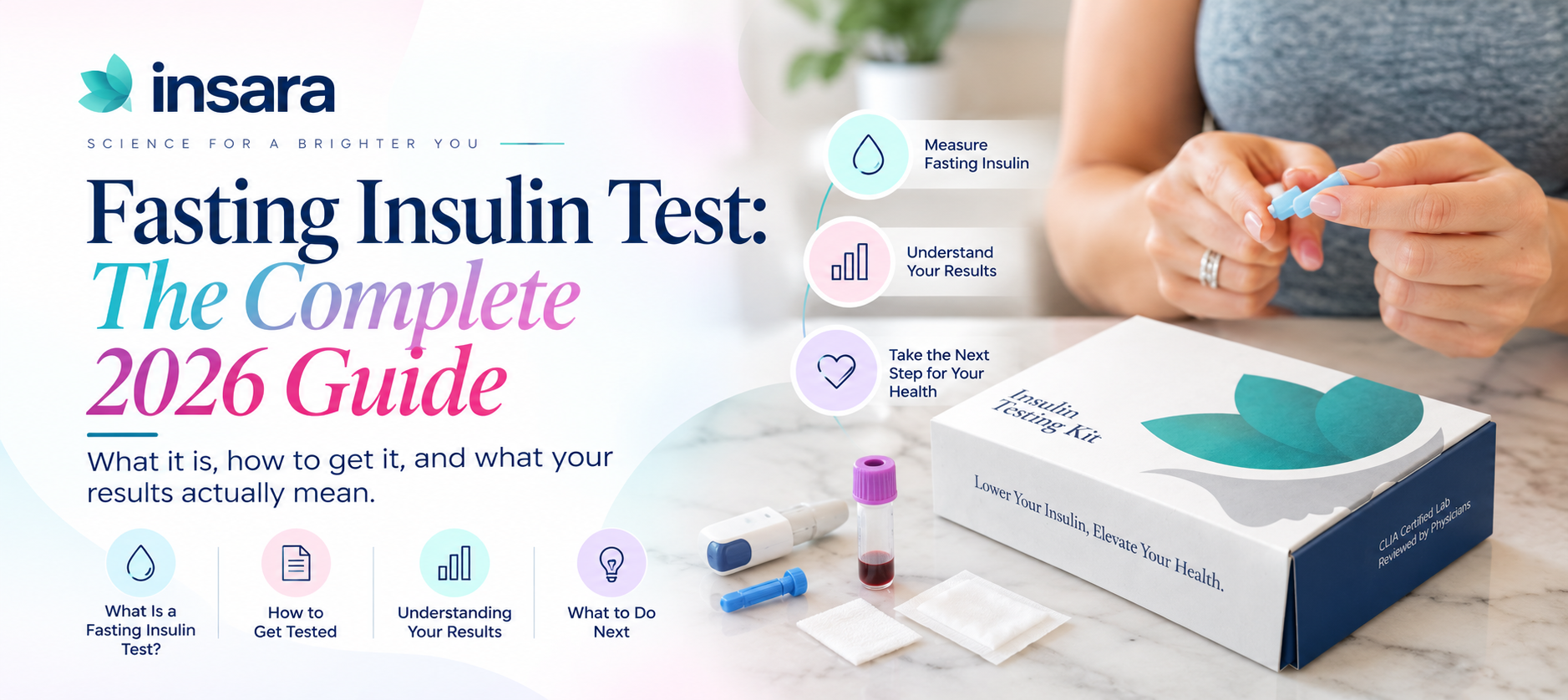
The Insara Metabolic Kit is a CLIA-certified and CAP-accredited at-home finger-prick test that measures fasting insulin alongside HbA1c, high-sensitivity CRP, cholesterol, and triglycerides. You collect the sample at home, mail it in with prepaid packaging, and receive results in the Insara App within 3 to 7 days. Each result comes with a plain-English explanation and educational context.
This option is particularly useful if your provider has not ordered fasting insulin, if you want to track your levels over time without scheduling repeat lab appointments, or if you want to see how your numbers change in response to lifestyle changes.
Explore the Insara Metabolic Kit
What to Do After Getting Your Fasting Insulin Results
Once you have a result, there are a few things worth knowing:
Do not interpret it in isolation. Fasting insulin should be read alongside fasting glucose, HbA1c, your symptom picture, and your clinical history. A single number does not tell the whole story.
Discuss it with a provider. If your result is above 8 mIU/mL, bringing it to a qualified healthcare provider for interpretation is the right step. Not all providers will be familiar with the research-based 8 mIU/mL threshold, so having that context ready is useful.
Use it as a baseline. Whatever your result is, it gives you a starting point. If you make lifestyle changes, retesting at 8 to 12 weeks tells you whether those changes are working. The Insara clinical research showed a 52% reduction in fasting insulin after only 8 weeks of following the Low Insulin Lifestyle.
Track it in the Insara App. The Insara App lets you log and track your fasting insulin over time, so you can see your trend even if you test through a provider rather than through the kit.
What Lowers Fasting Insulin?
The three clinical studies behind the Low Insulin Lifestyle showed consistent, significant reductions in fasting insulin through dietary and lifestyle changes alone:
- Pilot study: 52% drop in fasting insulin in 8 weeks
- Metabolic study: Improved fat-burning capacity alongside reduced insulin
- Randomised controlled trial (vs Metformin + standard care): 35% drop in fasting insulin in 8 weeks, during COVID
The core principles that produced these results are what the Insara App teaches: Understanding which foods drive the largest insulin responses, eating in a way that reduces insulin spikes throughout the day, moving after meals, and protecting sleep.
Frequently Asked Questions
Based on research literature, a fasting insulin below 8 mIU/mL is considered optimal. Values between 8 and 12 mIU/mL suggest early insulin resistance, 12 to 20 mIU/mL indicates moderate to significant elevation, and above 20 mIU/mL is markedly elevated. Standard lab reference ranges are typically set much higher, which is why a result can be reported as “normal” while still being above the evidence-based optimal threshold.
You can ask your healthcare provider to add it to your blood panel, order it directly through a lab service like Labcorp or Quest, or use an at-home CLIA-certified kit like the Insara Metabolic Kit, which delivers results in 3 to 7 days.
Yes. You should fast for at least 8 hours, ideally overnight, before testing. Water is acceptable. Coffee, food, and any supplements should be avoided during the fast.
Fasting insulin is not part of a standard blood panel because most clinical guidelines focus on glucose-based markers. It is almost always available if specifically requested, but it requires a separate order from your provider or an at-home test.
Yes. Some women with PCOS, particularly those with lean PCOS, have fasting insulin within the normal range because their liver efficiently clears insulin overnight. In these cases, the post-meal insulin response, measured through a glucose tolerance test with insulin, may be significantly elevated even when fasting levels appear normal.
For most women with PCOS or insulin resistance, retesting every 8 to 12 weeks during an active lifestyle intervention gives you meaningful feedback on whether your approach is working. After stabilising, testing occasionally as a monitoring tool is reasonable.
Yes. Fasting insulin is one of five markers the Insara Metabolic Kit measures, alongside HbA1c, high-sensitivity CRP, cholesterol, and triglycerides. Results are delivered in the Insara App within 3 to 7 days.
HOMA-IR (Homeostatic Model Assessment of Insulin Resistance) is a calculation using fasting insulin and fasting glucose together. It provides a more refined estimate of insulin resistance than either measurement alone. The formula is: fasting insulin (mIU/mL) x fasting glucose (mmol/L) / 22.5. Values above 2.0 to 2.5 are generally considered indicative of insulin resistance in research literature.