

There are hundreds of health apps marketed to women with PCOS/PMOS. Period trackers, symptom loggers, nutrition apps, hormone trackers, cycle awareness tools. The options are not the problem. Knowing which ones actually address the condition in any meaningful way — that is where things get complicated.
After 15 years researching insulin resistance and PCOS, I evaluated seven of the most commonly used apps through one specific lens: do they help women understand and address what is actually driving their symptoms, or do they simply record those symptoms?
Here is what I found.
The Testing Criteria
Every app was evaluated on five dimensions:
1. Insulin and metabolic education — Does the app explain the role of insulin in PCOS? Can it help a user understand why their symptoms exist, not just that they exist?
2. Symptom tracking depth — How many PCOS-specific symptoms can you track? Does the tracking connect to any meaningful analysis?
3. Lab result integration — Can you log fasting insulin, HbA1c, or hormonal markers? Can you track changes over time?
4. Lifestyle guidance quality — Is the food, movement, and sleep guidance evidence-based and relevant to the metabolic reality of PCOS specifically?
5. Outcome potential — Could using this app consistently, over 8 to 12 weeks, produce measurable improvements in how a woman with PCOS feels and what her lab results show?
The 7 Apps — Tested and Ranked
1. Insara ★★★★★
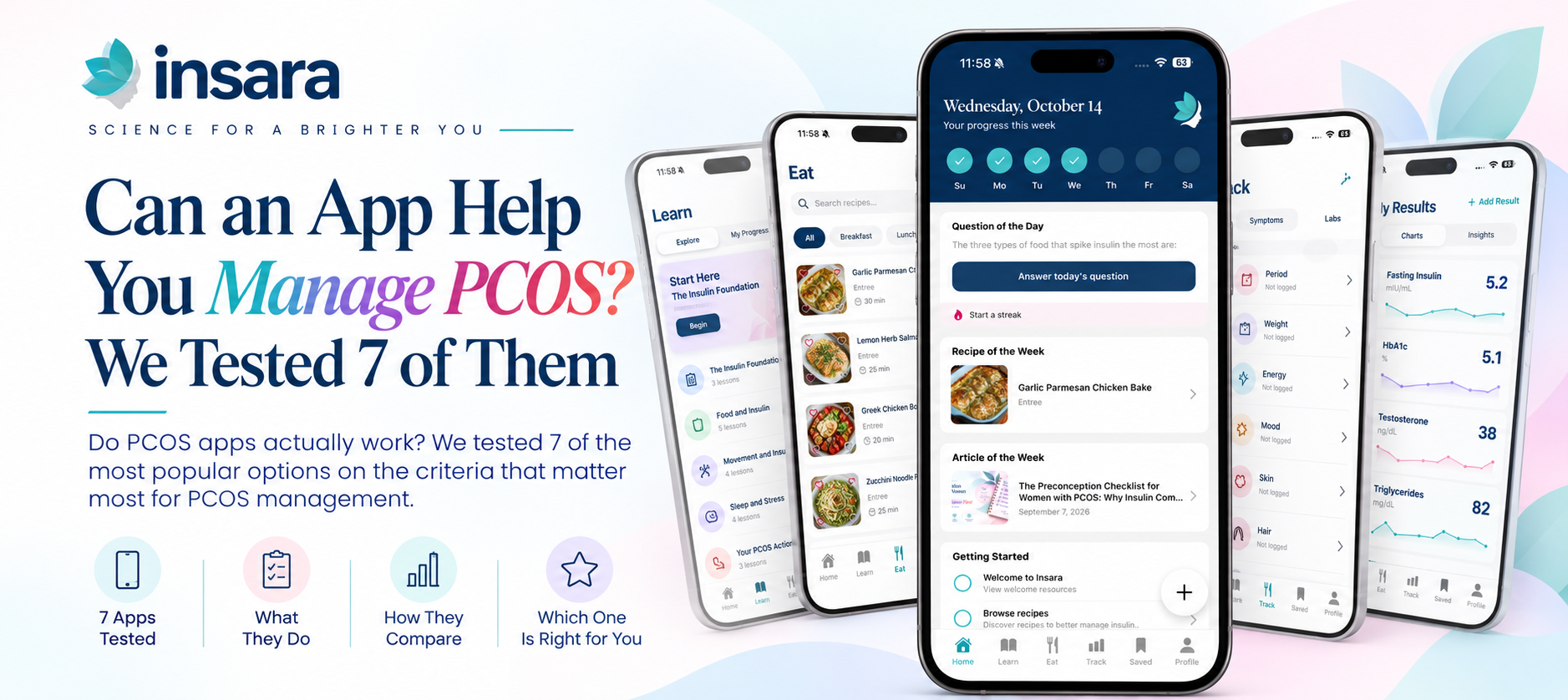
What it does: Insara is the only app in this list built specifically around insulin as the root driver of PCOS. The education program inside the app is based on three published clinical studies — including a randomized controlled trial — and teaches you why your symptoms are happening and what to do about it.
Insulin education: Full Low Insulin Lifestyle education program. Explains how food choices affect insulin, and how sleep and stress interact with insulin resistance.
Symptom tracking: PCOS-specific tracking including cycle, weight, energy, mood, skin, and hair.
Lab integration: Yes. Log fasting insulin, HbA1c, CRP, cholesterol, and triglycerides. Track over time. Integrates directly with the Insara Metabolic Kit for at-home testing.
Lifestyle guidance: Specific to insulin response — not generic “eat less, move more” advice. Based on 15 years of research and three clinical studies.
Outcome potential: High. The clinical studies behind Insara showed 52% drops in fasting insulin and 23% drops in free testosterone in eight weeks through the dietary approach the app teaches.
Verdict: The only app that addresses the mechanism driving PCOS rather than just its symptoms.
2. Flo
What it does: Flo is the world’s most downloaded period tracking app. For women with PCOS, its dedicated PCOS mode adjusts cycle predictions to account for irregular cycles, and the Premium symptom checker can flag patterns consistent with PCOS.
Insulin education: None.
Symptom tracking: Excellent — more than 70 trackable symptoms including PCOS-specific ones. Best symptom breadth of any app in this review.
Lab integration: No.
Lifestyle guidance: General health content from a team of 120+ doctors. Not insulin-specific.
Outcome potential: Low for the metabolic reality of PCOS. Flo tracks symptoms accurately but gives you nowhere useful to go with that information in terms of addressing the underlying hormonal driver.
Verdict: Best period tracker on the market. For PCOS management specifically, it is a good symptom record but not a management tool.
3. Clue
What it does: Clue is a privacy-first cycle and symptom tracker with strong science credentials. The irregular cycle mode handles PCOS-related unpredictability better than most apps. Data privacy is the strongest of any app in this list.
Insulin education: None.
Symptom tracking: Excellent — 200+ trackable factors. The most flexible tracking of any app in this review.
Lab integration: No.
Lifestyle guidance: Science-informed cycle content. No metabolic or insulin-specific guidance.
Outcome potential: Low for PCOS management specifically. Like Flo, Clue excels at tracking symptoms without connecting them to their cause.
Verdict: The best privacy-focused cycle tracker. Excellent complement to Insara for women who want both data privacy and metabolic education.
4. Natural Cycles
What it does: Natural Cycles is FDA-cleared as a digital contraceptive based on basal body temperature tracking. It is the most scientifically validated app for cycle-based fertility awareness.
Insulin education: None.
Symptom tracking: Limited to temperature and cycle data.
Lab integration: No.
Lifestyle guidance: None.
Outcome potential: Very low for PCOS management. The app assumes a predictable ovulation pattern that PCOS disrupts. Many women with PCOS report frustrating experiences with Natural Cycles precisely because their cycles do not conform to the expected temperature pattern the algorithm is built on.
Verdict: Well-validated for regular cycles. Poorly suited for PCOS. Not a management tool in any sense.
5. MyFitnessPal
What it does: MyFitnessPal is the world’s largest calorie and macro tracking app, with a food database of over 14 million items.
Insulin education: None.
Symptom tracking: No.
Lab integration: No.
Lifestyle guidance: Calorie and macronutrient focused. This is the fundamental problem for PCOS: calorie counting measures the wrong variable. A 400-calorie meal of refined carbohydrates and a 400-calorie meal of eggs and avocado produce radically different insulin responses, but MyFitnessPal treats them identically.
Outcome potential: Very low for PCOS specifically. Women with PCOS who have spent years tracking calories in MyFitnessPal often find it produces accurate nutritional data with no improvement in the hormonal patterns driving their symptoms. Because those patterns are insulin-driven, not calorie-driven.
Verdict: Excellent calorie tracker for general purposes. The wrong tool for PCOS management.
6. Glow
What it does: Glow is a period, fertility, and pregnancy tracking app with an active community of users. For women with PCOS who are trying to conceive, the community support is genuine and the fertility-focused tracking is useful.
Insulin education: None.
Symptom tracking: Good for fertility and pregnancy tracking. Limited for PCOS metabolic symptom tracking.
Lab integration: No.
Lifestyle guidance: General health and fertility content.
Outcome potential: Low for metabolic PCOS management. Useful for community support and cycle logging during the trying-to-conceive phase.
Verdict: Best community-focused option for TTC with PCOS. Not a management tool for the metabolic aspects.
7. Premom
What it does: Premom specialises in LH strip scanning using your phone’s camera, with sophisticated analysis of LH surge patterns over time. For women with PCOS trying to identify their ovulation window, this is genuinely useful — PCOS can produce multiple LH surges per cycle, and Premom helps identify which represents actual ovulation.
Insulin education: None.
Symptom tracking: Limited to LH and cycle data.
Lab integration: No.
Lifestyle guidance: None.
Outcome potential: Moderate for a very specific use case — identifying ovulation timing in PCOS. Not a broad management tool.
Verdict: Best specialist tool for ovulation prediction in PCOS. Not relevant outside that specific context.
Summary Comparison
| App | Insulin Education | PCOS Symptom Tracking | Lab Integration | Lifestyle Guidance |
|---|---|---|---|---|
| Insara | Yes — full program | Yes | Yes — with Kit | Yes — insulin-specific |
| Flo | No | Yes — 70+ | No | General only |
| Clue | No | Yes — 200+ | No | General only |
| Natural Cycles | No | Very limited | No | None |
| MyFitnessPal | No | No | No | Calorie focused |
| Glow | No | Moderate | No | General only |
| Premom | No | LH only | No | None |
The Verdict: Can an App Actually Help You Manage PCOS?
It depends entirely on which app and what you mean by “manage.”
If managing PCOS means tracking when your period might arrive and logging symptoms, Flo and Clue do that well. If it means identifying your ovulation window while trying to conceive, Premom is genuinely useful. If it means menopausal transition support, Balance (not in this test but reviewed elsewhere) fills that gap.
But if managing PCOS means understanding and addressing the root metabolic driver — elevated insulin — and actually changing the numbers that are producing your symptoms, only one app on this list does that.
Insara is not a perfect app. It does not have the cycle prediction sophistication of Flo, the data privacy credentials of Clue, or the community size of Glow. What it has is the only evidence-based, research-backed approach to the metabolic mechanism driving PCOS, delivered in a format that connects education to action to measurable testing.
For women who want to do more than track their symptoms, that is the meaningful distinction., eating in a way that reduces insulin spikes throughout the day, moving after meals, and protecting sleep.
Frequently Asked Questions
It depends on the app and what you define as “working.” Apps that track symptoms provide useful data but do not change symptoms. Insara is designed to provide education and tools that address the insulin-based mechanism driving PCOS, with clinical study evidence showing that the dietary approach it teaches can reduce fasting insulin by 35 to 52% and free testosterone by 23% in eight weeks.
Clue offers the broadest symptom tracking with 200+ trackable factors. Flo is close behind with 70+ symptoms and a PCOS-specific mode. Insara’s symptom tracking is more focused on PCOS-specific metabolic symptoms.
Yes — Insara is the only PCOS app that allows you to log and track fasting insulin, with direct integration to at-home CLIA-certified testing through the Insara Metabolic Kit.
Yes. Many women use Flo or Clue for cycle prediction and community, and Insara for the metabolic education and lab tracking. These complement each other without redundancy.
Insara is the only PCOS app built around insulin as the root cause of the condition. It includes a clinical research-backed education program, integrates with at-home metabolic testing, and allows you to track whether your lifestyle changes are producing measurable results in your lab values.