


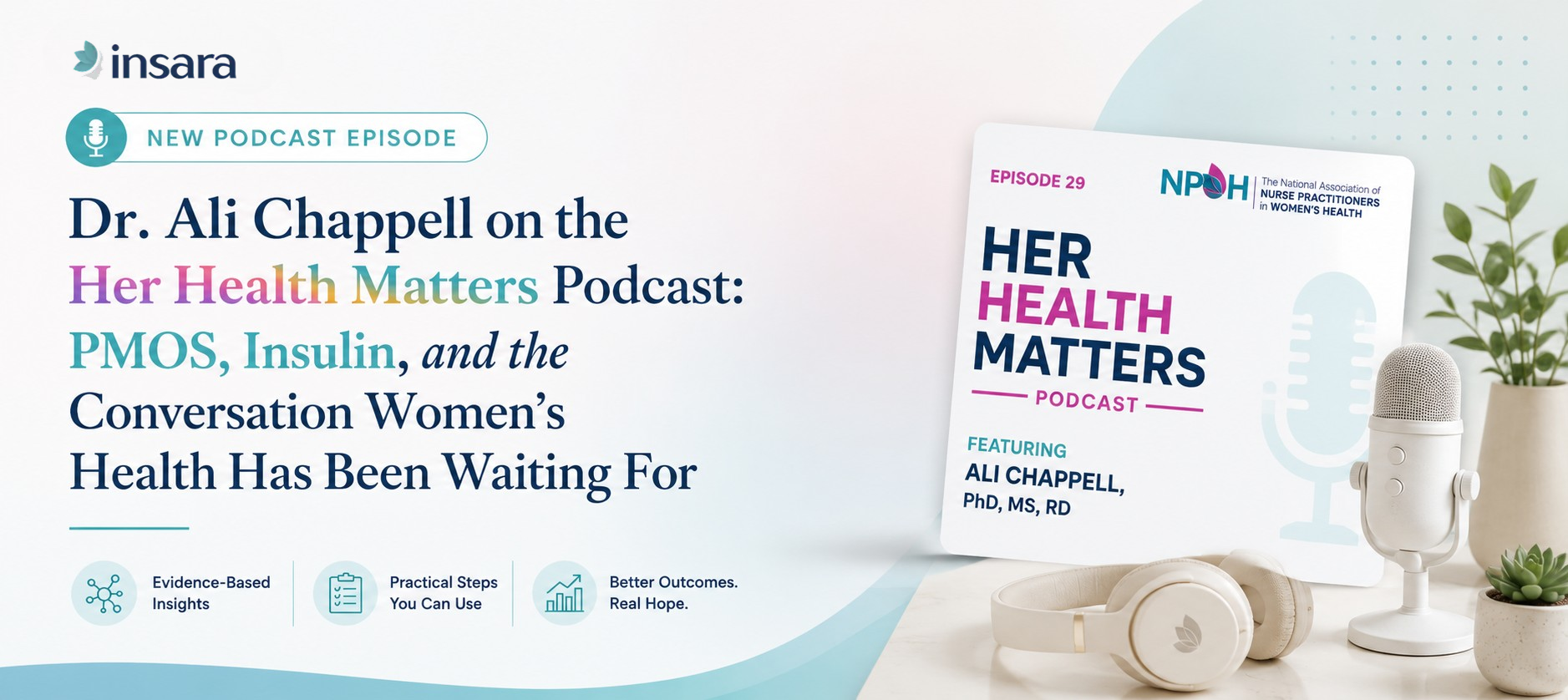
Episode 29 of the Her Health Matters podcast, produced by the National Association of Nurse Practitioners in Women’s Health, came out this week. I sat down with Komkwuan Paruchabutr, DNP, FNP-BC, WHNP-BC, CNM, FACNM, FNAP, FAAN, for 37 minutes and covered a lot of ground.
I want to share what we talked about here, because some of what came up in that conversation rarely makes it into written content. The insulin testing recommendations in particular are worth reading carefully if you are a patient trying to advocate for yourself or a provider who has questions about the numbers.

Where This All Started For Me
I have written about my personal diagnosis journey before, so I will keep this part brief. I started having symptoms at 14. Weight gain, severe acne, and a cycle that did not start until I was 16. When it did, I was having one period every six months to a year. I went on Accutane twice. I had multiple ultrasounds, and every time I was told the same thing: cysts on the ovaries, but it is okay, it is normal.
It was not until my fourth year at Texas A&M, studying nutrition, that a women’s health nurse practitioner gave it a name. She told me I had polycystic ovary syndrome, gave me birth control to regulate my cycle, and told me to watch my weight.
I was about to become a dietitian. I was exercising constantly. I was eating what anyone would describe as a healthy diet at the time. I was probably 50 pounds overweight and had been for years doing all of it.
The summer after graduation, I printed off journal articles and filled a binder. Everything pointed to the same thing. Insulin. Not glucose. Not carbohydrates as a general category. Insulin specifically, and the foods and behaviors that drive it. That was 2007. What I started doing that summer is what I now call the Low Insulin Lifestyle. By 2008 and 2009 I had lost the weight. My doctoral advisor told me to do a study on it.
I did. And that is how all of this started.
Why I Was Actually at the NPWH Booth All Those Years
Kwuan and I have known each other for a while. She brought up something I wanted to address directly.
Over the past several years, I have been to NPWH and ACOG multiple times. I always ask the same question at the booth. Do you test insulin in your patients with PCOS?
Two to three years ago at NPWH, roughly 70% said yes. At ACOG around the same time, it was closer to 10%. At NPWH last year, it was 85% or more. At ACOG a few months ago, it was closer to 60%. The gap is closing, and a lot of it is being driven by residents who learned the right way in training and are now going back to their attendings.
One story from NPWH last year that I keep sharing: a nurse practitioner came to the booth and told me her patient had an A1C of 4.9 and a fasting insulin of 79. Seventy-nine. And this patient had been managed based on her A1C alone for years.
The other quote I hear constantly, and I mentioned it in the episode, is this: I am not going to test something I do not plan to treat.
I understand where that comes from. But what it means in practice is that a provider is choosing to wait until a patient’s blood sugar is elevated, at which point the insulin resistance has been progressing for potentially a decade. Instead of saying: I know I cannot treat this with a medication today, but I want you to know this number is high and it is putting you at risk, and there are things we can do. That conversation is possible. That conversation is the one I want more providers to feel equipped to have.
The Genetics Behind Why Insulin Drives PMOS
Kwuan asked me to explain why insulin is the root driver even for women who do not fit the classic type 2 diabetes profile. I think this is one of the most important things to understand about PCOS/PMOS, and it is something I do not always get to explain in full.
Women with PCOS/PMOS are born with two things working against them simultaneously.
The first is a genetic predisposition to oversecrete insulin. Their pancreas produces more insulin in response to the same glucose load compared to women without the condition. This is not a behavior. It is a baseline.
The second is a genetic change in the ovaries involving a gene called P450c17, which encodes two enzymes. In a typical female body, these enzymes act as a rate-limiting step. The body does not want to produce too much testosterone, so it regulates how much is released. With PCOS/PMOS, those enzymes are upregulated. Which means when insulin is high, the ovarian cells are producing testosterone at a much higher rate than they should be.
When you combine both of these things, you have a situation where elevated insulin is constantly triggering androgen overproduction. The hirsutism, the acne, the clogged pores, the cysts on the ovaries from failure to ovulate, the irregular periods. Every single one of those things is downstream. The upstream driver is insulin.
This is why the name change to PMOS matters to me. It is not a condition of cystic ovaries. It is a condition of elevated insulin driving elevated androgens. And I was actually at the NIH renaming meeting when this conversation first started, in 2012. It has taken 14 years to get here. The updated diagnostic criteria are expected in 2028. And as I said in the episode: you cannot put the word metabolic into the name of a condition without having metabolic testing become standard. And testing A1C is not metabolic testing.
What I Actually Recommend for Insulin Testing
This section of the episode generated the most back and forth, and I want to put it in writing clearly because the numbers matter.
The first step: get a fasting insulin alongside a fasting glucose and HbA1c.
You need both pictures together. A fasting insulin on its own is more informative than an A1C alone, but having all three together gives you the full context. Fasting means at least 3 to 4 hours, but preferably overnight.
A fasting insulin should be below 8 mIU/mL.
The reference ranges that come back from standard labs are not evidence-based for metabolic health. They reflect a population average, not an optimal range. There is a well-accepted study published in a diabetes journal that broke results into quartiles and showed that anyone above 8 had exponentially increased risk. Below 8 is the sweet spot.
What to do when fasting insulin is normal but symptoms persist.
Some patients, particularly younger ones, have livers that are efficient enough to clear the insulin overnight. Their fasting number looks fine. But their bodies are still struggling in the postprandial window. If a patient has acne, irregular cycles, and no measurable fasting insulin elevation, I recommend a one-hour or two-hour oral glucose tolerance test.
For the one-hour test using a 50-gram load, post-prandial insulin should be below 50 mIU/mL.
For the two-hour test using a 75-gram load, the same threshold applies. In my clinical trials, participants’ post-prandial insulin levels reached as high as 226 mIU/mL before intervention, dropping to around 155 after the lifestyle intervention. Those are the numbers that tell you what the body is actually doing when it encounters a glucose load.
For anyone who is trying to conceive and about to invest in fertility treatments, I said this directly in the episode: it is worth sitting for an hour before spending significant money on IVF, when the reason you are not getting pregnant may be that your pancreas is oversecreting insulin and preventing ovulation. We have a published case series from an independent group of REIs showing that patients who had been unable to conceive, some after extended fertility treatment, conceived on an average of 86 days after starting the Low Insulin Lifestyle. 86 days. Because when you lower insulin, ovulation becomes possible again.
The Insara Rebrand, and What the App Does
I also talked about why we rebranded from Lilli Health to Insara. I have not explained this publicly very often, so it was a good moment to do it clearly. There is a very large pharmaceutical company called Eli Lilly…you may have heard of them ;). The names were too close, and we had to make a change. Insara: the “Ins” stands for insulin, and “ara” comes from a word meaning to illuminate. That is the mission. Make insulin visible, understandable, and actionable for both patients and providers.
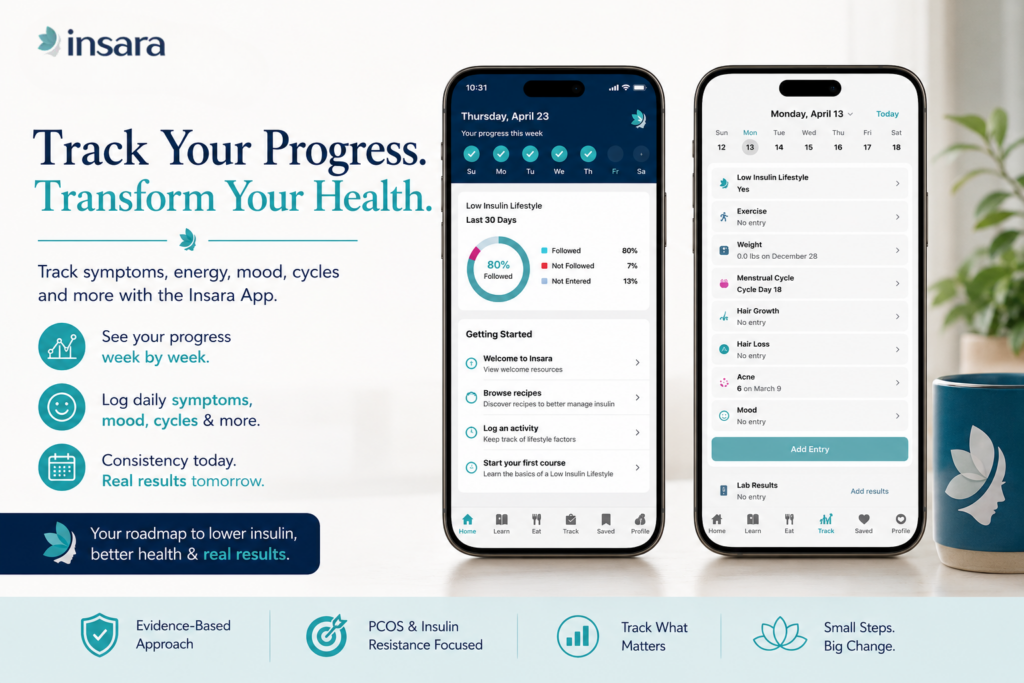
The app launched last June. It lets users track their cycles, symptoms, mood, and lifestyle adherence. It has education on which foods spike insulin and why, meal plans, and hundreds of insulin-friendly recipes. The goal is to give people the knowledge and the tools in one place, so that lowering insulin is not something abstract. It is something they can actually do in their daily life.
For Providers Who Are Listening
If you are a practitioner who found this post after listening to the episode, and you are not currently testing fasting insulin in patients with PCOS/PMOS, I want to say something clearly.
This is not a judgment. I spent years watching the gap between the science and the practice, and I understand how busy clinical life is and how slow guidelines move. But we are at a moment where the condition has officially been renamed to include the word metabolic. The diagnostic criteria update is coming in 2028. The conversation has shifted.
If you want a starting point, the number is straightforward. Fasting insulin below 8. Order it alongside the glucose and A1C. And if the fasting insulin is normal but your patient is symptomatic, consider the glucose tolerance test.
That is the beginning of what metabolic care actually looks like for this population.
Ready to Listen to the Full Episode?
The conversation covers more than I can capture in a blog post, including a specific exchange about how the dermatology community is beginning to connect the dots between acanthosis nigricans and insulin testing, and what that means for cross-specialty collaboration.
New to Insulin-Focused Nutrition?
If this episode or this blog post is the first time you are hearing that insulin and glucose are different things, and that normal blood sugar does not equal normal insulin, the free Low Insulin Lifestyle Guide is the most practical place to start.

Go Deeper: Tools for Understanding Your Insulin
Test Your Fasting Insulin at Home The Insara Metabolic Kit measures fasting insulin, HbA1c, inflammation, cholesterol, and triglycerides from a single finger prick. CLIA-certified lab accuracy. Results in your Insara App within 3 to 7 days. No lab visit required.
Track Your Symptoms and Progress with the Free Insara App Cycle tracking, symptom logging, insulin education modules, meal plans, and plain-English interpretation of your lab results, all in one place.
Read the Research Three published clinical studies including a randomized controlled trial comparing the Low Insulin Lifestyle to standard of care plus Metformin. Up to 52% drop in fasting insulin. Average of 19 pounds lost. All in 8 weeks.
Understand the Low Insulin Lifestyle Our books explain which foods spike insulin and which do not, including the counterintuitive ones, and how to build a way of eating that works with your hormones rather than against them.
Frequently Asked Questions
Her Health Matters is the official podcast of the National Association of Nurse Practitioners in Women’s Health (NPWH). It is hosted by Komkwuan Paruchabutr, DNP, FNP-BC, WHNP-BC, CNM, FACNM, FNAP, FAAN. The show covers topics in women’s and gender-related healthcare for clinicians and patients.
Fasting insulin should be below 8 mIU/mL based on published evidence. A study in a diabetes journal broke fasting insulin results into quartiles and found that anyone above 8 had exponentially increased associated health risks. This is different from the reference ranges returned by most standard labs, which are based on population averages rather than optimal metabolic health thresholds.
A glucose tolerance test measures how your body responds to a glucose load over one or two hours. For patients with PCOS/PMOS who have normal fasting insulin but ongoing symptoms like irregular cycles, acne, or fertility challenges, a glucose tolerance test can identify postprandial insulin oversecretion that a fasting test would miss. The target for a one-hour 50-gram load is a post-prandial insulin below 50 mIU/mL. A 75-gram two-hour test is also commonly used in research settings.
Women with PCOS/PMOS are born with two simultaneous predispositions. The first is a genetic tendency to oversecrete insulin. The second is a genetic change in the ovaries involving a gene called P450 C17 alpha, which encodes enzymes that normally act as a rate-limiting step for testosterone production. In PCOS/PMOS, these enzymes are upregulated, meaning elevated insulin triggers continuous androgen overproduction. Every major symptom of the condition, from acne to hair loss to missed periods to infertility, traces back to this mechanism.
The published evidence says yes. An independent case series from a group of REIs followed patients who had been unable to conceive, some through extended fertility treatment, and found that after starting the Low Insulin Lifestyle they conceived on an average of 86 days. When insulin drops, ovulation often follows. The connection between insulin and ovulatory dysfunction is direct: elevated insulin suppresses the LH/FSH signaling that drives ovulation.
The name changed earlier in 2026. Eli Lilly, a major pharmaceutical company, has a name that was too close to Lilli Health. The rebrand became necessary. Insara: the “In” represents insulin, and “sara” draws from a word meaning to illuminate. The mission remains the same. Make insulin visible, understandable, and actionable.
Episode 29 of Her Health Matters is available on Spotify. The episode is 37 minutes. Listen here