

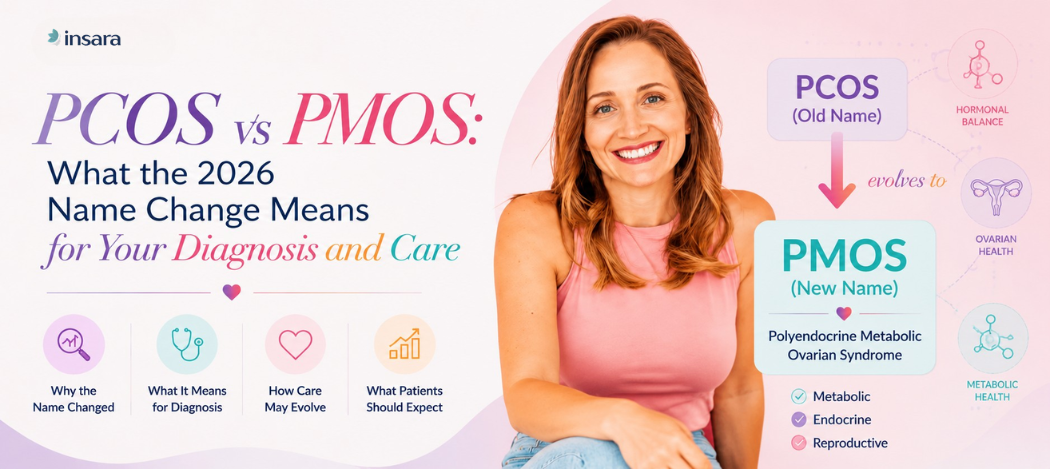
If you have PCOS, or suspect you might: you may have seen the news in May 2026: the condition known as PCOS has officially been renamed.
It is now called PMOS: Polyendocrine Metabolic Ovarian Syndrome.
One letter is different in the acronym. But the reasons behind it, and what it means for your diagnosis, treatment, and long-term care, are significant.
As someone who has lived with this condition since I was fourteen years old, studied it for fifteen years, and built Insara specifically to address the gaps in how it is treated, I want to walk you through exactly what this change means, and what it does not change.
Because while I celebrate the science finally catching up, I also want to be honest with you about what still needs to happen before this name change translates into better care at the ground level.
What Is PMOS? The Short Answer
PMOS stands for Polyendocrine Metabolic Ovarian Syndrome.It is the new official name for the condition previously known as Polycystic Ovary Syndrome (PCOS).
The renaming was announced on May 12, 2026, in a landmark paper published in The Lancet, developed through a global consensus process involving 56 leading academic, clinical, and patient organizations, including the Endocrine Society and the International Androgen Excess and PCOS Society, and drawing on more than 22,000 survey responses from patients and health professionals worldwide.
The condition itself has not changed. The biology has not changed. What has changed is that the medical community has officially acknowledged what many researchers, clinicians, and patients have been saying for years: the old name was misleading. And that had real consequences.
Why PCOS Needed a New Name
To understand why PMOS matters, you need to understand what was wrong with PCOS.
“Polycystic Ovary Syndrome” implies that the defining feature of this condition is cysts on the ovaries. But here is what most people are never told: many women with PCOS never have ovarian cysts at all. What is visible on ultrasound are small antral follicles, immature follicles that have not developed properly, not pathological cysts in the clinical sense.
The name was not just inaccurate. It was actively harmful.
When a name points to the ovaries as the primary issue, the entire focus of diagnosis and treatment follows that pointer. Doctors look at the ovaries. They look at cycles. They look at the reproductive system. And they frequently miss the most important driver of this condition entirely.
They miss insulin.
For decades, the metabolic features of this condition: the insulin resistance, the elevated fasting insulin, the inflammation, the cardiovascular risk: were treated as secondary concerns at best and irrelevant at worst. The name told clinicians where to look. They looked at ovaries. They missed metabolism.
The result was that up to 70% of women with this condition remained undiagnosed. Of those who were diagnosed, most were never tested for insulin resistance. And most were never told that insulin was likely driving the symptoms they were experiencing.
This is not a small gap. This is why so many women spend years being told their labs are normal, their symptoms are manageable, and that they just need to eat less and move more.
What PMOS Actually Means: Breaking Down the Name
Each word in Polyendocrine Metabolic Ovarian Syndrome is doing real clinical work. Here is what it means:
Polyendocrine
The word “polyendocrine” acknowledges that this condition involves multiple interacting hormonal disturbances, not just one. Insulin, androgens, LH, FSH, and neuroendocrine hormones are all part of this picture. This is not a single-hormone problem. It never was.
Metabolic
This is the word that matters most to me, and to the work we do at Insara.
“Metabolic” formally recognizes that insulin resistance, elevated fasting insulin, and metabolic dysfunction are core features of this condition, not complications or side effects, but central drivers. It also acknowledges the elevated risks for type 2 diabetes, cardiovascular disease, and long-term metabolic health that come with this diagnosis.
Insulin is now, officially, in the name.
Ovarian
The connection to ovarian dysfunction, ovulatory disturbances, androgen excess, and fertility is retained. It is still part of the picture. But it is no longer the whole picture or the primary label.
What Stays the Same
Before we go further, the most important practical thing to know is this: the diagnostic criteria for PMOS are the same ones used to diagnose PCOS.
Doctors will continue looking for:
- Irregular or absent ovulation
- Signs of elevated androgens: acne, excess facial or body hair, hair thinning
- Relevant ultrasound findings where appropriate
Your existing diagnosis does not change. Your symptoms do not change. Your prescription, if you have one, does not change.
Both names: PCOS and PMOS: will be used interchangeably during a three-year transition period. If your doctor still says PCOS, that is completely normal. You are not being treated for something different.
What This Name Change Should Actually Mean for Your Care
Here is where I want to be both honest and optimistic.
The renaming is meaningful. But naming something “metabolic” and actually treating the metabolic features are two very different things.
Right now, most standard PCOS/PMOS workups still do not include a fasting insulin test. Your doctor might check your glucose. They might check your HbA1c. But fasting insulin: the number most directly tied to what is driving your symptoms: is still not part of standard care for most women.
Glucose can be completely normal while fasting insulin is already significantly elevated. This can go on for years, sometimes a decade or more, before it shows up in any standard test. The name PMOS says “metabolic.” But until “metabolic” means “we test insulin as standard care,” many women will continue to go undiagnosed or undertreated.
The name change is a step. A meaningful, important, long-overdue step. But it is the beginning of the work, not the end of it.
That gap is exactly what Insara was built to fill. Insulin testing, insulin education, and real tools to understand and address the root metabolic driver, not just the symptoms. That has been our mission from day one, and it matters more now than ever.
Why Insulin Is Still the Missing Piece
Even with the new name, I want to make sure this is clear: putting “metabolic” in the name of a condition does not automatically mean more women will get their insulin tested.
Up to 95% of women with PCOS/PMOS have some degree of insulin resistance. Fasting insulin should ideally be below 8 mIU/mL. Most standard lab reference ranges do not flag anything until 25 mIU/mL or higher: meaning a result of 18 could be returned to you as “normal” even when it reflects significant insulin resistance.
If your insulin has never been tested, you do not have a complete picture of what is driving your condition.
This is not a criticism of your doctor. It is a reflection of a system that is slowly changing. You can advocate for yourself by asking for a fasting insulin test by name. And if your provider is not ordering it, you can test it from home with the Insara Metabolic Kit: a CLIA-certified, CAP-accredited finger-prick panel that measures fasting insulin, HbA1c, inflammation (hs-CRP), cholesterol, and triglycerides, with results in your Insara App within 3–7 days.
The Transition Timeline
The three-year transition period (2026–2028) means that PMOS will be gradually adopted across:
- Clinical guidelines: updated diagnosis and management protocols
- Medical education: how doctors are taught to identify and treat the condition
- Disease classification systems: ICD codes and insurance billing
- Research funding and publications: how the condition is studied going forward
- Patient materials: what you receive at your appointment
This rollout will not happen overnight, and it will not happen uniformly. Some clinics will adopt the new language quickly. Others will take years. During this period, seeing both PCOS and PMOS used interchangeably is completely normal.
A Note on Insulin Testing During the Transition
One of the most important things you can do right now: whatever stage of diagnosis or treatment you are in: is know your fasting insulin number.
Not your glucose. Not just your HbA1c. Your fasting insulin.
If your provider has tested it, excellent: now you have a baseline. If they have not, this is the moment to ask. You can bring this article to your next appointment and use it to start that conversation.
Insara was built specifically for this gap. Whether you use the Insara Metabolic Kits to test at home or bring your results from your provider into the Insara App for plain-English interpretation and tracking, the goal is the same: give you the data you need to understand what is actually happening in your body.
Because with PCOS or PMOS, the biology has always been the same. It has always come down to insulin. And now, the name finally says so too.

Ready to Start Understanding Your Metabolic Health?
Whether you are newly diagnosed, years into your PCOS/PMOS journey, or just beginning to connect the dots between your symptoms and your insulin levels, Insara was built to support you at every step.
→ Learn more about PCOS/PMOS and insulin resistance
Tools to Support Your PCOS/PMOS Journey
The name changed. The biology did not. If you are ready to understand what is actually driving your symptoms, and what you can do about it: here is where to start:
Test Your Insulin at Home The Insara Metabolic Kit measures fasting insulin, HbA1c, inflammation, cholesterol, and triglycerides from a single finger-prick. CLIA-certified lab accuracy. Results in your Insara App within 3–7 days. No lab visit. No prescription.
→ Shop the Insulin Testing Kit
Track Your Progress with the Insara App Free to download. Log your symptoms, cycle, mood, lab results, and Low Insulin Lifestyle journey: all in one place, with plain-English guidance at every step.
→ Download the Insara App
Understand the Low Insulin Lifestyle Our science-backed books explain how different foods affect insulin, why calorie counting fails women with PCOS/PMOS, and how to start making changes that actually move the needle.
→ Explore the Books
Read the Research Three published clinical studies, including a randomized controlled trial, showing what actually happens when women lower their insulin: up to 52% reduction in fasting insulin, 19 lbs average weight loss, and improved hormonal markers: all in 8 weeks.
→ View Our Research
Frequently Asked Questions About PCOS vs PMOS
PMOS stands for Polyendocrine Metabolic Ovarian Syndrome. It is the new official name for the condition previously known as Polycystic Ovary Syndrome (PCOS). The renaming was announced on May 12, 2026, in The Lancet and is endorsed by 56 leading medical and patient organizations, including the Endocrine Society.
PCOS and PMOS are the same condition, just different names. PMOS (Polyendocrine Metabolic Ovarian Syndrome) is the updated terminology that better reflects what the condition actually is: a complex hormonal and metabolic disorder, not primarily an ovarian one. The diagnostic criteria, symptoms, and treatment approaches have not changed with the name: only the label has.
PCOS was renamed PMOS because the old name was medically inaccurate and had real consequences for patient care. The term “polycystic ovary” implied that cysts on the ovaries were the defining and primary feature of the condition, but many women with PCOS never have cysts. More importantly, the name directed clinical attention toward the ovaries and away from the metabolic features: especially insulin resistance: that drive most of the condition’s symptoms. The new name formally acknowledges the hormonal and metabolic nature of the condition.
No. If you have been diagnosed with PCOS, your diagnosis remains valid. The diagnostic criteria used to identify PMOS are the same Rotterdam criteria previously used for PCOS. Nothing about your existing diagnosis, prescription, or treatment plan changes because of the renaming. During the transition period (2026–2028), both terms will be used interchangeably.
Not necessarily: at least not right away. The three-year transition period allows time for clinical guidelines, medical education, and documentation systems to update. During this time, you may see both PCOS and PMOS used by different providers, clinics, and healthcare systems. If your doctor still says PCOS, that is completely normal. You are being treated for the same condition.
Yes. PCOS/PMOS is one of the most common causes of ovulatory infertility, but a diagnosis absolutely does not mean pregnancy is out of reach. Many women with PCOS/PMOS conceive naturally, and many more do so with appropriate support. When insulin resistance is addressed: through lifestyle changes like the Low Insulin Lifestyle, or in some cases medication: ovulation can often regulate and fertility improves. Research published in Human Reproduction in 2026 found that women with insulin resistance who received treatment had live birth rates of 40.2% compared to 9.6% in untreated insulin-resistant women. Knowing and managing your insulin levels is one of the most impactful steps you can take if pregnancy is your goal.
Not immediately. Treatment approaches remain the same for now: lifestyle modifications, medications like Metformin or hormonal contraceptives where appropriate, and symptom management. However, the new name is expected to drive broader adoption of metabolic screening, including fasting insulin testing: as standard care. The hope is that over time, “metabolic” in the name will translate into more providers testing insulin and offering metabolic support, not just reproductive and dermatological symptom management.
Possibly, and this is one of the most important reasons the name change matters. Many women have been incorrectly told they do not have PCOS because their ultrasound did not show cysts. But cysts are not required for a diagnosis, and the diagnostic criteria are based on ovulation patterns, androgen levels, and clinical features, not the presence of visible cysts. If you have been dismissed for this reason, bringing up the PMOS name change with a new provider may open a more thorough conversation. You can also ask specifically for a fasting insulin test and an androgen panel, regardless of what your ultrasound showed.
It means insulin is now officially recognized as central to this condition, not a side issue. Practically, this should translate into more providers including insulin testing in their PCOS/PMOS workup, broader recognition of non-reproductive symptoms (fatigue, weight gain, inflammation, blood sugar dysregulation), and more comprehensive treatment approaches that include metabolic support, not just reproductive management. In the meantime, if your current care does not include insulin testing, you can advocate for it, or test at home with the Insara Metabolic Kit.
The paper is: Teede HJ et al., “Polyendocrine metabolic ovarian syndrome, the new name for polycystic ovary syndrome: a multistep global consensus process.” Published May 12, 2026, in The Lancet. DOI: 10.1016/S0140-6736(26)00717-8. The process behind it involved 56 organizations, 22,000+ survey respondents from patients and clinicians worldwide, and over 14 years of global advocacy and research.
Yes, if it opens the door to a better conversation about your care. Use the name change as an opportunity to ask questions you may not have asked before: specifically, whether your care plan includes metabolic screening, and whether your fasting insulin has been tested. You can also use the Insara patient education resources to prepare for that conversation.