

If you are in your 40s and find that nothing you used to do for weight management is working anymore, you are not imagining it. Something has genuinely changed. The question is what, and more importantly, why.
The most common explanation offered is “it is just menopause.” Or “your metabolism is slowing.” Or “you need to eat less and exercise more.”
None of these answers are satisfying, because none of them are quite right.
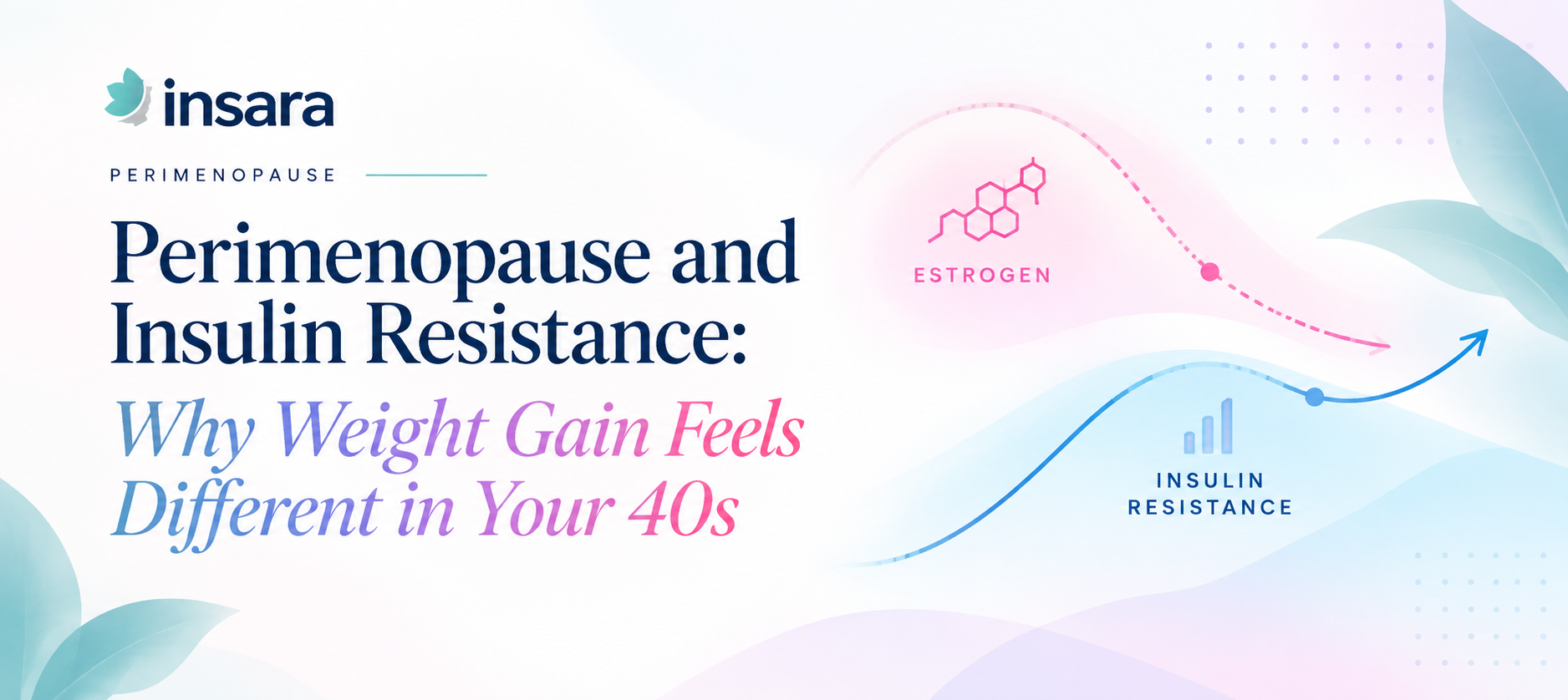
What has changed, specifically, is the relationship between estrogen and insulin resistance. And until you understand that relationship, almost everything you try for weight management in your 40s will underperform, because it is addressing the wrong mechanism.
The estrogen-Insulin Connection
Estrogen has an insulin-sensitizing effect. In the presence of healthy estrogen levels, cells respond efficiently to insulin’s signal. Glucose is moved into cells effectively. The pancreas does not need to produce as much insulin to achieve the same result. Fasting insulin stays lower, the fat-storing signal stays quieter, and the body’s natural capacity to use stored fat for energy remains accessible.
During perimenopause, typically the mid-to-late 40s, estrogen levels begin to fluctuate and gradually decline. Every drop in estrogen reduces this insulin-sensitizing effect.
Cells become progressively less responsive to insulin. The pancreas compensates by producing more. Fasting insulin rises. The fat-storing signal becomes louder. The body’s ability to access stored fat for energy declines.
This is why the same food choices that felt manageable in your 30s begin producing different results in your 40s. Your insulin response to those foods has worsened. The hormonal environment has shifted in a direction that makes fat storage easier and fat release harder, not because you are eating more or moving less, but because the underlying metabolic machinery is operating differently.
Why the Fat Moves to Your Abdomen
One of the most characteristic and frustrating features of perimenopausal weight change is where the fat accumulates: the abdomen.
This is not random. estrogen promotes fat storage in the hips, thighs, and buttocks—peripheral fat that is metabolically relatively inert. When estrogen declines, this hormonal direction changes. Fat preferentially accumulates in the visceral compartment, such as the abdomen and surrounding the internal organs.
Visceral fat is metabolically very different from peripheral fat. It is highly active: it produces inflammatory cytokines, releases fatty acids directly into the hepatic portal circulation, and, critically for the insulin resistance cycle, makes cells throughout the body more resistant to insulin’s signal.
This means the perimenopausal shift toward abdominal fat storage does not just change your shape. It directly worsens the insulin resistance that was already worsening due to estrogen decline. The two processes reinforce each other.
More visceral fat creates more insulin resistance. More insulin resistance makes fat harder to mobilize and easier to store. The cycle is self-reinforcing.
Why Calorie Restriction Stops Working in Your 40s
If insulin resistance is the driver of perimenopausal weight changes, the failure of calorie restriction makes complete sense.
Calorie restriction addresses total energy intake. It does not address the hormonal signal telling your body to store rather than burn that energy. When insulin is chronically elevated, as it is when estrogen declines, and insulin resistance worsens, the body is receiving a persistent fat-storage signal regardless of how few calories you consume.
Many women in their 40s describe eating “almost nothing” and still not losing weight. They are not failing at willpower. They are applying the right effort to the wrong mechanism.
The right approach reduces the dietary drivers of insulin elevation (starches, sugar, certain types of dairy, whey protein) while supporting the metabolic environment through adequate protein, sleep, and movement. This is what the Low Insulin Lifestyle does.
The Sleep-Cortisol Amplifier
Perimenopause and sleep disruption are deeply connected. Night sweats, hormonal fluctuations, and increasing anxiety during the menopausal transition make quality sleep harder to achieve.
This matters metabolically because every night of disrupted sleep raises cortisol. Cortisol directly raises insulin. For a woman whose insulin is already rising due to estrogen decline, the sleep disruption of perimenopause adds another layer of insulin elevation on top of an already-worsening baseline.
Many women in their 40s are experiencing the combined effects of:
- Estrogen-decline-driven insulin resistance
- Sleep-disruption-driven cortisol elevation → additional insulin elevation
- Stress-driven cortisol elevation → additional insulin elevation
- Visceral fat accumulation → additional insulin resistance
These are not separate problems. They are different inputs feeding the same central mechanism: elevated insulin.
What Women With PCOS Experience Differently
For women with PCOS/PMOS who enter perimenopause, this transition is amplified.
Women with PCOS already have a genetic predisposition to oversecrete insulin. They have spent years managing, with varying degrees of success, the metabolic consequences of chronically elevated insulin. Estrogen’s insulin-sensitizing effect has buffered the genetic predisposition throughout their reproductive years.
As estrogen declines, that buffer weakens. The genetic predisposition to oversecrete insulin, combined with the estrogen-related loss of insulin sensitivity, can produce a meaningful acceleration of insulin resistance during perimenopause that is noticeably worse than what women without PCOS experience.
This is why PCOS symptoms that felt manageable in the 30s can feel more severe in the mid-to-late 40s. The metabolic ground has shifted.
What Actually Helps
Address the Dietary Insulin Load Directly
Reducing the foods that produce the largest insulin responses is the most direct lever available for perimenopausal insulin resistance. The foods with the highest insulin spikes are starches (grains, beans, potatoes), sugar (including natural sugars like honey, maple syrup, and agave nectar), sweetened drinks, milk and non-fermented dairy products, and whey protein.
Replacing these with lower-insulin alternatives, such as non-starchy vegetables, whole fruits, quality protein sources, and healthy fats, reduces the dietary insulin stimulus that compounds hormonally driven insulin resistance.
This is not the same as low-carbohydrate eating. Non-starchy vegetables and most fruits have carbohydrates but produce significantly lower insulin responses than starches. The distinction is insulin response, not carbohydrate content.
Move After Meals and Prioritize Resistance Training
Post-meal walking reduces the post-meal insulin response directly. This is as relevant at 47 as it is at 27.
Resistance training two to three times per week builds and preserves the muscle mass that supports insulin sensitivity over time. It is one of the most evidence-supported interventions for perimenopausal metabolic health that does not require dietary restriction.
Test Your Fasting Insulin
You cannot manage what you do not measure. If you are in your 40s and noticing your weight and energy shifting in ways that feel hormonally driven, fasting insulin is the most directly actionable measurement available.
The Insara Metabolic Kit measures fasting insulin alongside HbA1c, CRP, cholesterol, and triglycerides from a single at-home finger-prick sample, with results in the Insara App within 3 to 7 days.
Explore the Insara Metabolic Kit
Consider a Provider Conversation About HRT
Hormone replacement therapy (HRT) restores some of the estrogen that is declining during perimenopause and, with it, partially restores the insulin-sensitizing effect of estrogen. The cardiovascular and metabolic risk reduction data on HRT, when started during the perimenopausal transition rather than well after menopause, have become substantially more favorable in recent years.
This is an individual clinical decision that depends on your health history, your symptoms, and your risk profile. A provider experienced in perimenopausal care can help you weigh it. But the connection between HRT, estrogen, and insulin sensitivity is a legitimate part of the perimenopause-weight conversation that does not always get raised.
Frequently Asked Questions
The hormonal driver is different. Estrogen decline reduces its insulin-sensitizing effect, cells become more insulin resistant, fasting insulin rises, and the fat-storage signal becomes louder. Additionally, fat redistribution shifts toward the abdomen, where visceral fat directly worsens insulin resistance. This mechanism is hormonally and metabolically distinct from a simple calorie surplus.
Not as effectively as it did in earlier decades, because the mechanism driving weight changes is hormonal rather than simply caloric. Reducing dietary insulin, through food quality choices rather than calorie quantity, addresses the actual driver more directly.
Test your fasting insulin. If it is above 8 mIU/mL, insulin resistance is contributing to the pattern. Other signs include abdominal weight accumulation, energy dips after carbohydrate-heavy meals, strong carbohydrate cravings, and fatigue disproportionate to sleep quantity.
Yes. The clinical studies behind Insara were conducted in PCOS populations, but the principles, reducing dietary insulin through food quality, address the same mechanisms that drive perimenopausal insulin resistance. Many women in their 40s and 50s find the Low Insulin Lifestyle more effective than calorie-based approaches specifically because it addresses the hormonal mechanism rather than the caloric arithmetic.
Yes, substantially. While the estrogen-driven component will continue to change until menopause, the dietary and lifestyle drivers of insulin resistance are modifiable at any life stage. Many women see meaningful improvements in fasting insulin, triglycerides, and abdominal weight distribution within eight to twelve weeks of consistently following the Low Insulin Lifestyle principles.
Estrogen has an insulin-sensitizing effect. HRT that restores estrogen levels can partially restore this effect, reducing insulin resistance in women experiencing estrogen-decline-driven metabolic changes. This is a clinically relevant consideration for women with PCOS in perimenopause, where estrogen decline amplifies an already-elevated insulin baseline. Discuss with a qualified healthcare provider.
Women with PCOS have a genetic predisposition to oversecrete insulin. Estrogen normally buffers this predisposition with its insulin-sensitizing effect. As estrogen declines during perimenopause, this buffer weakens, and the PCOS-related insulin predisposition can express itself more severely. Women with PCOS often experience more pronounced insulin resistance worsening during perimenopause than women without the condition.